BLOG HOME

Events

  • Searching for Exoplanets Born Outside the Milky Way

    Friday January 12, 2024, 7:00pm – UW Space Place
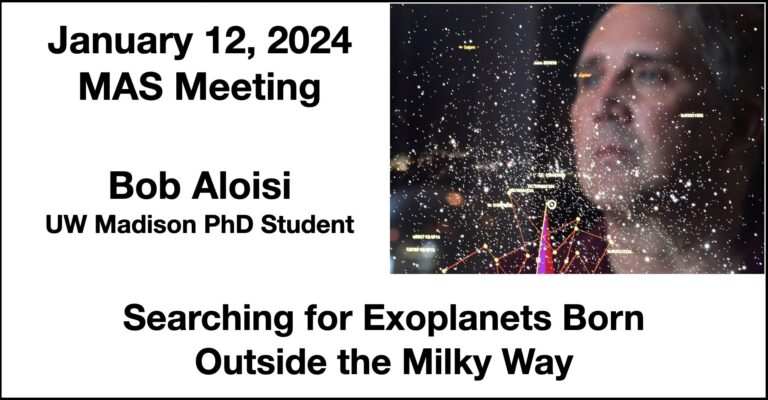
    Over 5500 exoplanets have been found orbiting stars in the Milky Way, with projections that most stars host planets. This poses the question of whether planets also exist orbiting the remnant stars of smaller dwarf galaxies that merged with the Milky Way, and if so, how do they differ from their Milky Way counterparts? VOYAGERS Views of Yore – Ancient Gaia-Enceladus Exoplanet Revealing Survey is a radial velocity search using precision spectrographs to find exoplanets orbiting low metallicity ([Fe/H] from -2.8 to -0.x, Vmag 8 to 10 stars born in the dwarf galaxy Enceladus, which merged with the Milky Way galaxy about 10 Gyr ago. A pool of 22 candidates from Enceladus F, G, and K class stars have been screened using reconnaissance observations from the TRES spectrograph. Precision RV measurements are ongoing over 3 years using the NEID, HARPS-N and CARMENES spectrographs. Ultimately, we hope the survey will lead to a better understanding of when and where in our universe’s history planets – and life – can form.

    Bob Aloisi is a 4th year Ph.D. student at the UW Madison. His return to graduate school follows a nearly 30 year career working in consumer products development. Bob’s work on exoplanets makes use of local telescopes such as the Bell Burnell Observatory at Promega, formerly the MAS Oscar Mayer Observatory, formerly the UW Madison Student Observatory.

    DUE TO SEVERE WINTER WEATHER THIS PRESENTATION WILL BE VIRTUAL VIA ZOOM.
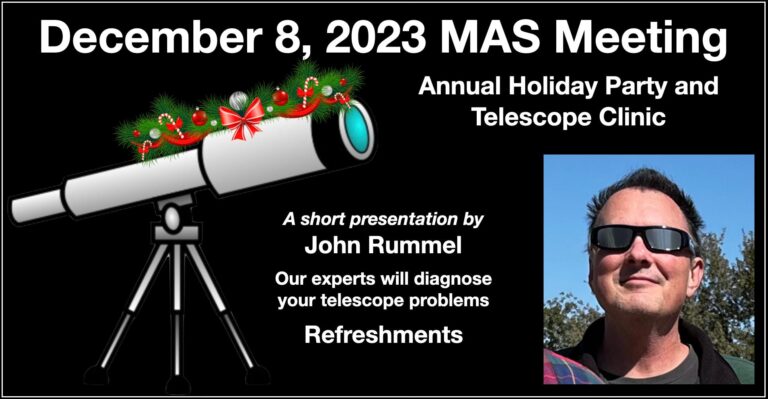
  • Annual Holiday Party and Telescope Clinic

    Friday December 8, 2023, 7:00pm – UW Space Place

    So You Want To Buy a Telescope?

    There will be a short (15-minute) presentation by John Rummel, former president and current historian of the Madison Astronomical Society:

    Do you have a telescope that’s giving you problems? Has it been gathering dust in your closet instead of giving great views of the moon and planets? Are you stuck and can’t get to the next step? Our experts can help you diagnose the issues and get it figured out. Bring your telescope to this meeting and we’ll take a look at it with you.

    Also, feel free to bring a holiday snack to share with the group. Cookies, brownies, or similar finger foods are preferred for minimal cleanup.

    This meeting will take place in-person at our usual Space Place classroom location. It will also be streamed live to our YouTube channel at https://www.youtube.com/@madisonastronomicalsociety.

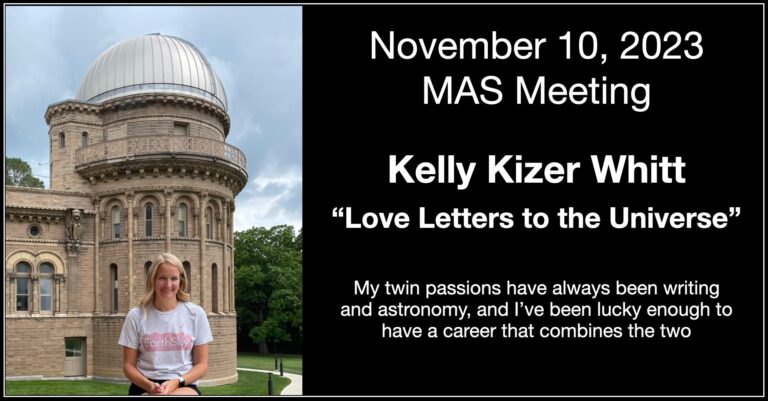
  • Love Letters to the Universe

    November 10, 2023, 7:00pm – UW Space Place

    “My twin passions have always been writing and astronomy, and I’ve been lucky enough to have a career that combines the two. As a science journalist, I focus on astronomy and earth topics, and as an author, some of my books center on space. I will talk about the path of my career and how I branched off into creative endeavors and also share some of my writing.”

    Kelly Kizer Whitt has been a science writer specializing in astronomy for more than two decades. She began her career at Astronomy Magazine and is currently a writer and editor at EarthSky.org. She’s also an author of nine books, including a children’s picture book, Solar System Forecast, and a young adult dystopian novel, A Different Sky.

    This meeting will take place in-person at our usual Space Place classroom location. It will also be streamed live to our Youtube channel at https://www.youtube.com/@madisonastronomicalsociety.

  • Moon Over Monona Terrace

    Friday October 20, 2023, 7:00pm-9:30pm – Monona Terrace Conference Center

    FREE and Open to the Public

    For more information, and to get your FREE tickets, visit: https://www.mononaterrace.com/event-group/moonmononaterrace/

    FREE ticket required for admission. Tickets are required for all attendees; subject to venue capacity and are issued on a first come first serve basis. There is a limit of 8 tickets per patron.

    Explore the surface of the Moon and other celestial objects through telescopes provided by MAS members.

    Young and old alike are invited to view the Moon and other celestial objects, such as Jupiter and Saturn, through a multitude of different telescopes provided by the Madison Astronomical Society (MAS). Activities include short kid-friendly presentations about the moon and other celestial phenomena, plus a kids’ fun zone with educational games and prizes!

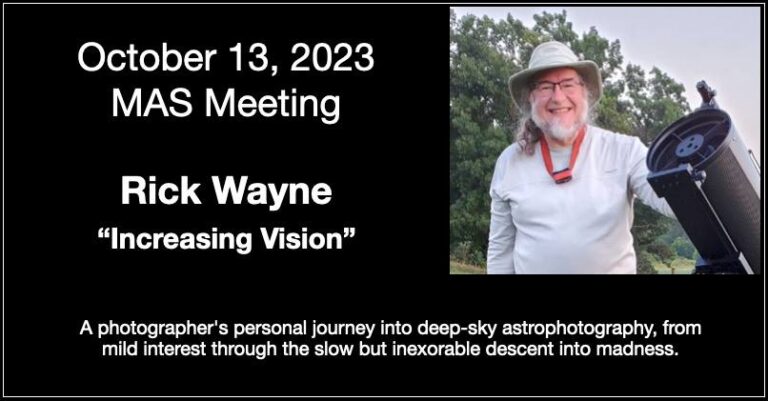
  • Increasing Vision

    Friday October 13, 2023, 7:00pm – UW Space Place

    A photographer’s personal journey into deep-sky astrophotography, from mild interest through the slow but inexorable descent into madness. Lessons learned. Pitfalls explored (from the bottom). Equipment choices, techniques and resources for beginners: how to put a toe in the deep-sky or planetary waters and avoid most of the piranhas.


    Rick Wayne is a husband, a dad, and a software engineer for UW Soils, where he writes agronomic decision-support software (motto: “Sweet Bog where do I put all these tons of cow poop?”)

    He is an Outdoor Emergency Care instructor and runs the regional instructor-development program for the Ski Patrol, and holds National Appointment #11910. His lifelong interest in photography led to his education (though not to his employment) as a photojournalist. He sort of toppled into deep-sky astrophotography on the way to something else.

    This meeting will take place in-person at our usual Space Place classroom location. It will also be streamed live to our Youtube channel at https://www.youtube.com/@madisonastronomicalsociety.

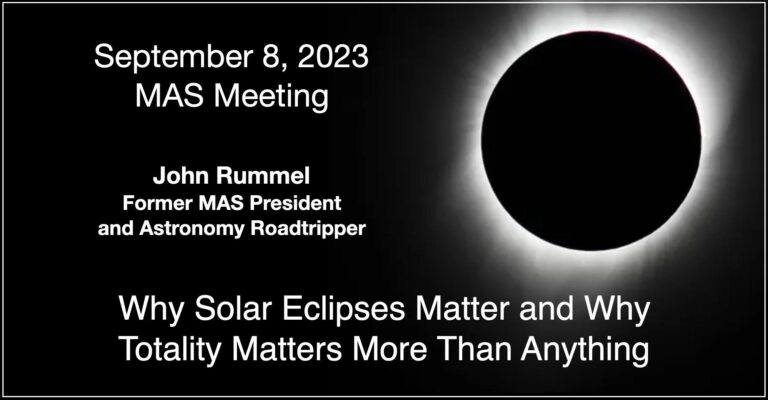
  • Why Solar Eclipses Matter and Why Totality Matters More Than Anything

    Friday September 8, 2023, 7:00pm – UW Space Place

    There are two important solar eclipse events coming up: the October 14 2023 Annular Solar Eclipse, and the April 8 2024 Total Solar Eclipse. This talk will be a general introduction to solar eclipses with a quick look back at the August 2017 event (seen by many MAS members) but a thorough look ahead to the two upcoming events. Why should you care and how should you prepare? Everything you need to know about planning for and then observing these two events will be covered.

    John Rummel is a long-time member and past president of the Madison Astronomical Society. He made his reservations for a place to stay in Texas nearly 3 years ahead of the April 2024 total eclipse!

    This meeting will take place in-person at our usual Space Place classroom location. It will also be streamed live to our Youtube channel at https://www.youtube.com/@madisonastronomicalsociety.

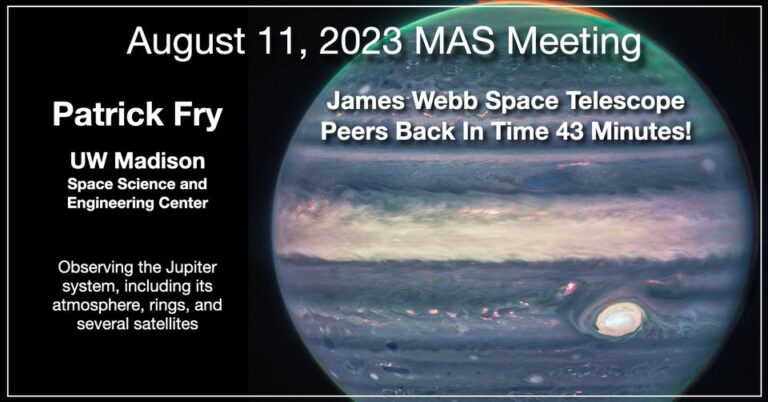
  • The James Webb Space Telescope Peers Back In Time 43 Minutes

    Friday August 11, 2023, 7:00pm – UW Space Place

    Though we may think of the James Webb Space Telescope (JWST) as primarily intended to observe the early universe and the most distant galaxies, it also counts observing bodies in our own solar system as part of its mission. As part of JWST’s Early Release Science program, a group of astronomers and planetary scientists proposed and and was selected to observe the Jupiter system, including its atmosphere, rings, and several satellites. Many of that progam’s observations have now been completed and results are being published. This talk will discuss the capabilities of several of JWST’s instruments including the Near Infrared Camera (NIRCam), Near Infrared Spectrograph (NIRSpec) and Mid Infrared Instrument (MIRI), and what observations they conducted. (Jupiter image processing by Ricardo Hueso and Judy Schmidt.)

    Dr. Pat Fry is a researcher at UW-Madison’s Space Science and Engineering Center. During his career, he has acquired, processed, and analyzed solar system data from the Galileo Probe’s Net Flux Radiometer, Hubble’s series of visible and near infrared cameras, Cassini’s imaging camera and imaging spectrograph, as well as conducting observations of Jupiter, Uranus, and Neptune at NASA’s Infrared Telescope Facility (IRTF) and the Keck Observatory on Hawaii’s Mauna Kea mountaintop.

    This meeting will take place in-person at our usual Space Place classroom location. It will also be streamed live to our Youtube channel at https://www.youtube.com/@madisonastronomicalsociety.

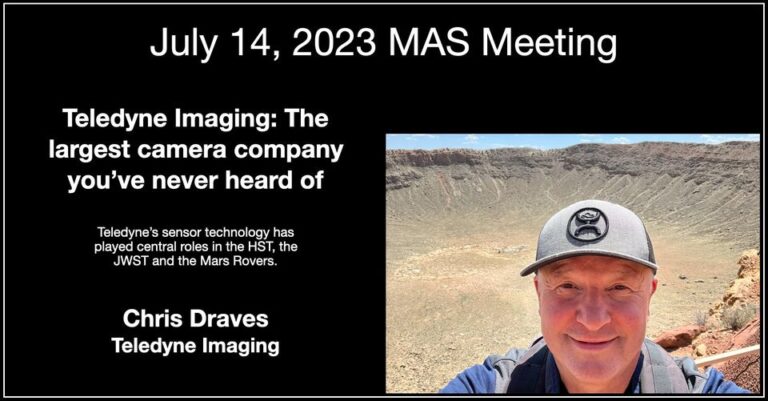
  • Teledyne Imaging: The largest camera company you have never heard of!

    Friday July 14, 2023, 7:00pm – UW Space Place

    Teledyne Imaging’s image sensors, cameras, and imaging components have played central roles in groundbreaking projects like the Hubble Telescope, the Mars Rovers, and the James Webb Telescope. We will explore the latest industry trends in CCD and CMOS sensors, and delve into Teledyne’s extensive influence on astronomy and the space program, revolutionizing the way we observe and explore the cosmos.

    Chris Draves is an accomplished professional with over 20 years of experience in the scientific camera and image sensor industry. Having worked with leading brands like Princeton Instruments, Andor Technology, Fairchild Imaging, and currently Teledyne Imaging, he has held various positions in technical sales, business development, and product management. Throughout his career, Draves has provided high-performance cameras to research labs worldwide, supporting a wide range of applications. He currently resides in Madison, WI.

    This meeting will take place in-person at our usual Space Place classroom location. It will also be streamed live to our Youtube channel at https://www.youtube.com/@madisonastronomicalsociety.

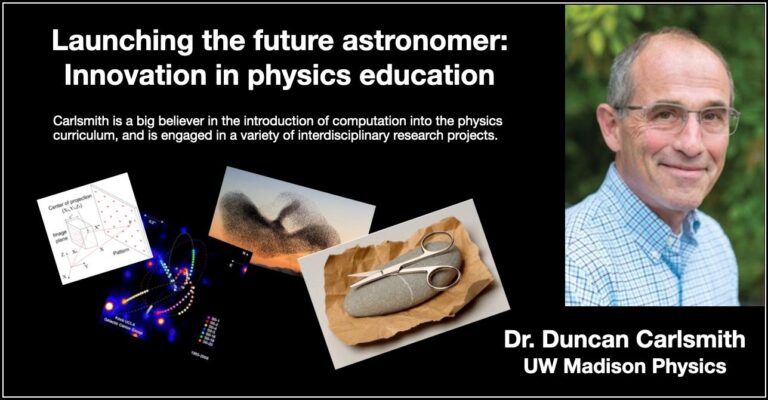
  • Launching the future astronomer: Innovation in physics education

    Friday June 9, 2023, 7:00pm – UW Space Place

    Dr. Carlsmith will describe innovations in an introductory physics course providing modern research skills through immersion in big and small, arcane and applied science. Astrophysical topics include asteroids, exoplanets, black holes. Fun topics include computer vision, dappled light, the world’s simplest digital microscope, and mobile phone astrometry.

    Professor Carlsmith is a faculty member of the Physics Department at the University of Wisconsin-Madison. His research in experimental elementary particle physics has spanned proton-antiproton collisions with the Collider Detector Facility at Fermilab Tevatron, detector development for the SDC experiment at the SSC, proton-proton collisions with the Compact Muon Solenoid detector at the CERN Large Hadron Collider, and a search for WIMP dark matter with the LZ two-phase liquid xenon detector at SURF.

    Dr. Carlsmith is presently focused on innovation in teaching and learning, especially the introduction of computation into the physics curriculum, and is engaged in a variety of interdisciplinary research projects.

    This meeting will take place in-person at our usual Space Place classroom location. It will also be streamed live to our Youtube channel at https://www.youtube.com/@madisonastronomicalsociety.

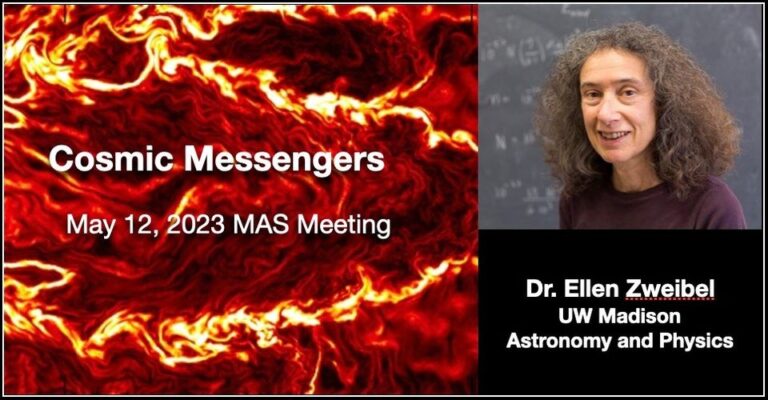
  • Cosmic Messengers

    Friday May 12, 2023, 7:00pm – UW Space Place

    At the May 12, 2023 meeting of the Madison Astronomical Society, we’ll have a special presentation by Dr. Ellen Zweibel of the UW Madison Astronomy and Physics departments: “Cosmic Messengers.”

    Astronomers have long observed the Universe in visible light and its shorter and longer wavelength cousins. Now, subatomic particles and ripples in spacetime have been added to the mix. I’ll describe how these different sources of information can be pieced together to observe some of the most energetic events in the Universe, now and in the past.

    Bio: Ellen Zweibel has been a professor of Astronomy and Physics at the University of Wisconsin since 2003. Prior to that, she served on the faculty of the University of Colorado. She grew up in New Jersey, and was educated at the University of Chicago and Princeton University.

    This meeting will take place in-person at our usual Space Place classroom location. It will also be streamed live to our Youtube channel at https://www.youtube.com/@madisonastronomicalsociety.