BLOG HOME

Events

  • History and Tradition in the MAS

    Friday October 11, 2024, 7:00pm – UW Space Place
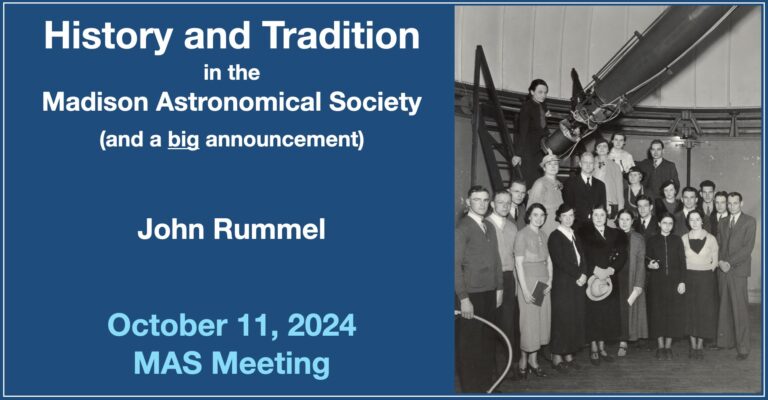
    In 1990-91, the Madison Astronomical Society confidently celebrated its 60th anniversary with a slate of special events and public outreach. Everyone knew that the club had formed in 1930. That had been the conventional wisdom for decades and there appeared to be documentary evidence to back it up. But conventional wisdom is not always wise and mistakes do happen. What IS the club’s actual birthdate?

    Anniversaries, birthdays and other traditions are important. Honoring the past preserves those traditions and helps us focus on who we are and where we’re headed. MAS anniversaries and traditions are meaningful and we’re fortunate that much of our story has been preserved. We’ll honor a few of those traditions at this meeting and spend a little time probing the origins of our club and the ways early members celebrated its founding and continued existence. We’ll also make a special announcement about the revival of a tradition that you won’t want to miss.

    This meeting will take place in person at our usual Space Place classroom location. It will also be streamed live to our YouTube channel at https://www.youtube.com/@madisonastronomicalsociety.
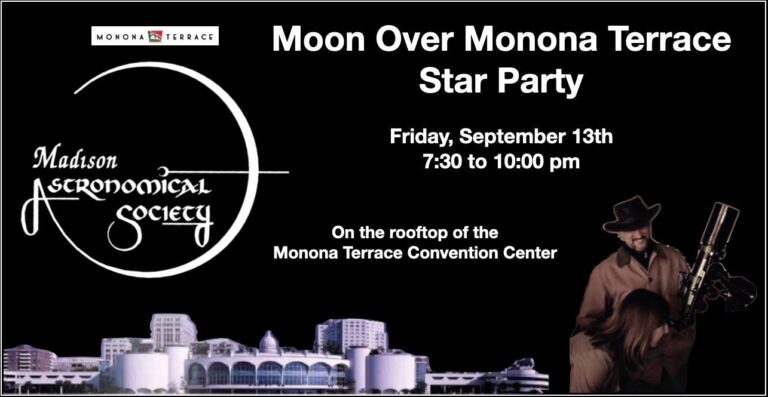
  • Moon Over Monona Terrace

    Friday September 13, 2024, 7:30pm – 10:00pm – Monona Terrace Convention Center

    2024 Moon Over Monona Terrace is on September 13th

    What: One of the biggest star parties in the US
    When: Friday, September 13th, 7:30 to 10:00 pm
    Where: Monona Terrace Convention Center (rooftop)

    MAS will have multiple telescopes, binoculars and other instruments set up so members of the public can explore the moon and other celestial objects.

    Free and open to the public but tickets are required for admission. Visit https://www.mononaterrace.com/event-group/moonmononaterrace to get tickets.

  • MAS Member Discussion Roundtable

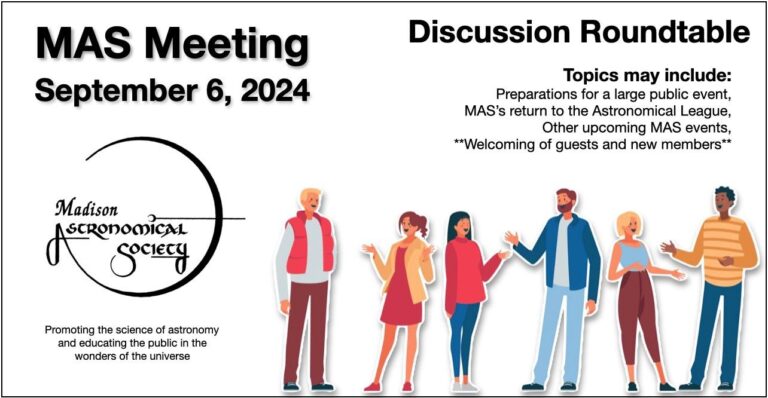
    Friday September 6, 2024, 7:00pm – UW Space Place

    Due to a conflict created by our Moon Over Monona Terrace star party on Sept. 13th, the regular September monthly meeting will take place on Friday, September 6th. There will be no guest speaker presentation at this meeting. Rather, we will have a moderated discussion among all those present. Topics can include:

    Preparing for a large public event: Our upcoming “Moon Over Monona Terrace” event is one of the largest star parties in the midwest. Are you ready for hundreds of people wanting to look through your telescope?

    Back in the Astronomical League: MAS recently rejoined the AL 30 years after quitting. Do you have thoughts?

    Welcome of new members and visitors: have you only recently joined the MAS? This is a chance for us to meet new members and visitors (and get your questions answered!).

    Other topics – as raised by attendees at the meeting – will be discussed as time permits.

    This meeting will take place in person at our usual Space Place classroom location. It will also be streamed live to our YouTube channel at https://www.youtube.com/@madisonastronomicalsociety

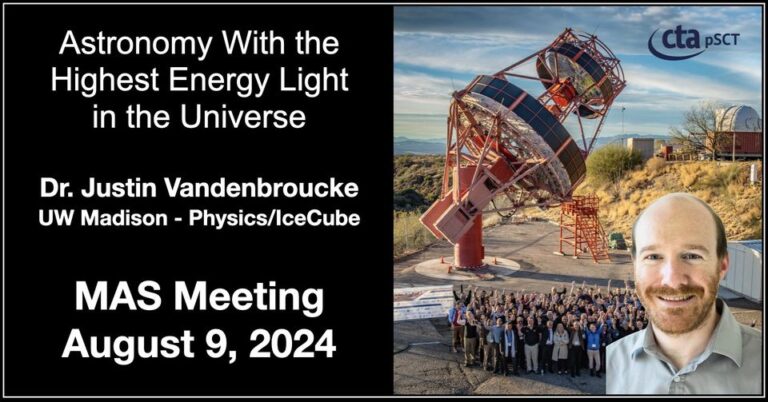
  • Astronomy With the Highest Energy Light in the Universe

    Friday August 9, 2024, 7:00pm – UW Space Place

    Major breakthroughs have been made in astronomy by expanding observations to far longer and far shorter wavelengths than we can see with our eyes. The shortest-wavelength photons are gamma rays, the highest energy photons in the Universe. Some of these photons are trillions of times more energetic than the human eye can detect. There is a surprising variety of astronomical sources glowing or flashing in these very-high-energy gamma rays. They are powered by some of the most extreme objects in the Universe: exploding stars, white dwarfs, neutron stars, and black holes. I will describe the science that very-high-energy gamma rays enable and the prospects for the Cherenkov Telescope Array Observatory, an international project currently under construction.

    Justin Vandenbroucke is an associate professor at the University of Wisconsin–Madison, in the Physics Department and Wisconsin IceCube Particle Astrophysics Center. His research focuses on gamma-ray astronomy with the Cherenkov Telescope Array Observatory, neutrino astronomy with the IceCube Neutrino Observatory, and citizen science with the Distributed Electronic Cosmic-Ray Observatory. Vandenbroucke obtained his PhD in Physics from UC-Berkeley and held postdoctoral positions as a Kavli Fellow at Stanford University and NASA Einstein Fellow at SLAC National Accelerator Laboratory. Vandenbroucke is currently a UW–Madison Vilas Associate.

    This meeting will take place in person at our usual Space Place classroom location. It will also be streamed live to our YouTube channel at https://www.youtube.com/@madisonastronomicalsociety.
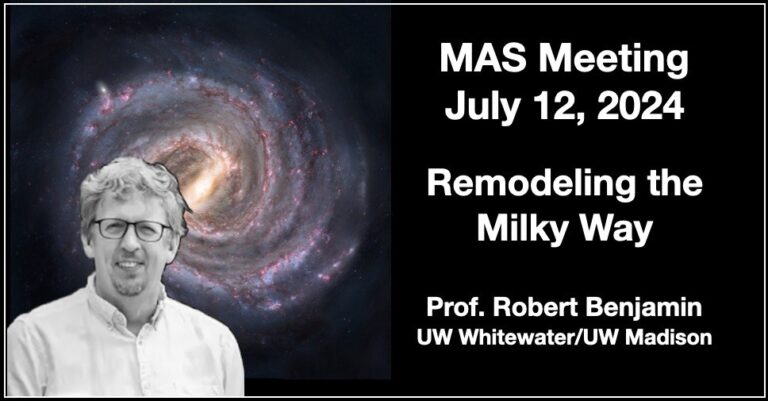
  • Remodeling the Milky Way

    Friday July 12, 2024, 7:00pm – UW Space Place

    Thanks to high precision stellar distances and velocities obtained with the European Space Agency mission Gaia, astronomers are doing all sorts of Milky Way investigations that I personally never imagined would be possible. From identifying the ingredients that first formed the Milky Way, to unscrambling the young clusters around the Sun back to their point(s) of origin 40 million years ago to building highly accurate three-dimensional maps of the interstellar medium, we are in a Golden Age for Galactic astronomers. I will share some of these advances, how they are unravelling our old picture of the Milky Way, and pointing the path to something better.

    If you’re interested in some background before the talk, check out the recent article about Bob’s research in Scientific American: https://www.scientificamerican.com/article/the-new-story-of-the-milky-ways-surprisingly-turbulent-past/

    Prof. Benjamin obtained his PhD at the University of Texas at Austin in 1994 and has been a professor of physics at the University of Wisconsin-Whitewater since 2003. Although he is about to retire from his position at UW-W this August to provide home care for his mother, he plans to continue his research on the Milky Way as a professor emeritus and is looking forward to the launch of two upcoming NASA missions: SPHEREx (2025) and Roman (2027).

    This meeting will take place in person at our usual Space Place classroom location. It will also be streamed live to our YouTube channel at https://www.youtube.com/@madisonastronomicalsociety.
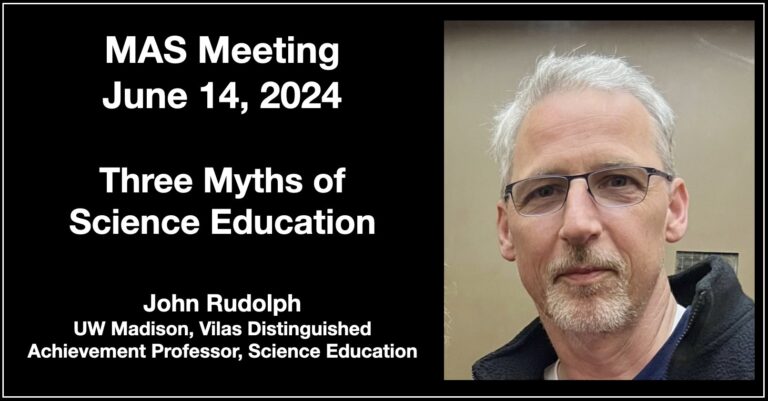
  • Three Myths of Science Education

    Friday June 14, 2024, 7:00pm – UW Space Place

    Few people question the importance of science education in American schooling. It’s the key, after all, to economic growth, develops the ability to reason more effectively, and enables us to solve everyday problems. Good science teaching results in all these benefits and more—or so we think. But what if all this is simply wrong? What if the benefits we assume science education produces turn out to be an illusion, nothing more than wishful thinking? In this talk, Rudolph will examine the reasons we’ve long given for teaching science and assesses how they hold up to what we know about what students really learn in science classrooms and what research tells us about how people actually interact with science in their daily lives. The results may be surprising. Instead of more and more rigorous traditional science education to fill the STEM pipeline, Rudolph will challenge us to think outside the box of traditional instruction and make the case for an expansive science education aimed instead at rebuilding trust between science and the public—something desperately needed in our current era of impending natural challenges and science denial


    John L. Rudolph is the Vilas Distinguished Achievement Professor of Science Education at the University of Wisconsin-Madison. His main area of research focuses on the history of science education in American high schools. He also writes about issues related to the nature of science in the present-day school curriculum and on how the history, philosophy, and sociology of science have been used in science education research. He received his Ph.D. from the University of Wisconsin-Madison in curriculum and instruction and history of science. Prior to his current appointment, he spent a number of years teaching physics, chemistry, and biology in middle schools and high schools across Wisconsin. He is past editor-in-chief of the Wiley & Sons journal Science Education and a National Academy of Education/Spencer Postdoctoral Fellow.

    This meeting will take place in person at our usual Space Place classroom location. It will also be streamed live to our YouTube channel at https://www.youtube.com/@madisonastronomicalsociety.
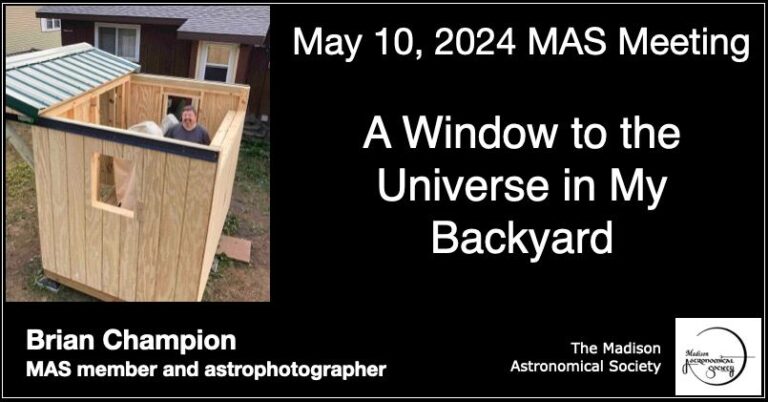
  • A Window to the Universe in My Backyard….

    Friday May 10, 2024, 7:00pm – UW Space Place

    Having a backyard observatory is like having my own window to the universe. Any clear night I can roll the roof back and marvel at all the wonders available to see.

    Having a backyard observatory means not having to spend time setting up or breaking down my equipment. I can be ready to start imaging in just a few minutes and in the morning; just roll the roof closed and I can head off to work.

    I designed my observatory with Shapr3D on my iPad. I looked at many different designs and chose the most useful features for my own needs.

    Brian’s biographical sketch:

    My astrophotography journey started a little over 25 years ago as an extension of my photography hobby. I got interested after attending a public viewing put on by the Starsplitters in Wyalusing State Park, a group I currently belong to. I got to see a few of the planets and several star clusters. I got pretty interested and started looking for a telescope. My first was a 10” Meade LX200. I shot with that scope for several years, but I found myself losing interest because the scope was heavy and hard to set up. Fast forward to the ’17 solar eclipse. At the eclipse, I got to look through a solar hydrogen alpha telescope, and my interest was reinvigorated. My main interests in astrophotography are nebulae and solar.

    For the last 20-plus years, I’ve worked as a manufacturing engineer for a small local company. They make plastic under the hood engine parts for all the major OEM’s. My focus there is automation, machine vision, robots, and injection molding. Outside of work, my hobbies include photography and woodworking.

    This meeting will take place in person at our usual Space Place classroom location. It will also be streamed live to our YouTube channel at https://www.youtube.com/@madisonastronomicalsociety

  • 1919 and the new Universe… Echos and Beyond, the Modern Eddington Experiment

    Friday April 12, 2024, 7:00pm – UW Space Place

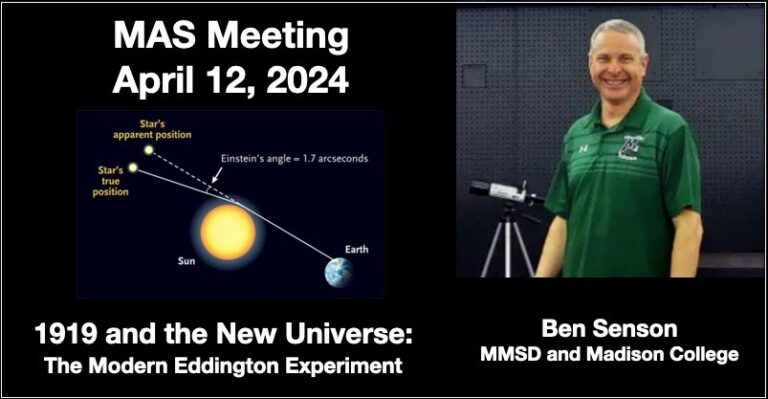
    When Einstein published his general theory of relativity it reinvented one of the most fundamental characteristics of the Universe, and as such it came with predicted phenomena that would settle the issue of whether or not the “King” of Newtonian gravitation was really dead. One of the predictions concerns the existence of a value for the curvature of spacetime based on the presence of mass. Given sufficient mass, like that of a typical yellow G2 star, it was predicted that the “straight line” motion of a beam of light through space-time would have to have this curvature of spacetime itself encoded on its path through a deflection of the observed location of the source of the light compared to an observation made when the massive object was not along the line of sight. In his 1911 paper, “On the Influence of Gravitation on the Propagation of Light” Einstein draws the conclusion that… “A light ray going past the Sun would accordingly undergo deflection by the amount of 0.83 seconds of arc. The angular distance of the star from the center of the Sun appears to be increased by this amount. As the fixed stars in the parts of the sky near the Sun are visible during total eclipses of the Sun, this consequence of the theory may be compared with experimental evidence. … It would be urgently wished that astronomers take up the question here raised, even though the considerations presented above may seem insufficiently established or even bizarre. For, apart from any theory, there is the question of whether it is possible with the equipment at present available to detect an influence of gravitational fields on the propagation of light.” In 1919, during the Solar eclipse on May 29th, astronomers Dyson, Eddington, and Davidson attempted what is now generally referred to as “The Eddington Experiment”, seeking to confirm or challenge the existence of the newly predicted warpage of spacetime. What did they discover? Was the question resolved with this effort? Fast forward to April 8, 2024, and two teams of observers in Mexico and Texas as they take on Einstein’s challenge with modern optics and CMOS detectors in “The Modern Eddington Experiment.” Is it finally time to throw away general relativity? Does solar eclipse data make this theory questionable?? As this description is written before the eclipse, I honestly don’t yet know… but you will be one of the first to hear our suspicions.

    Ben Senson is the Planetarium Director for the MMSD Planetarium. He has been an educator for more than 30 years with the Madison Metropolitan School District as a classroom teacher of the Earth sciences, physics, aerospace engineering, and astronomy. At Madison College, he is a senior part-time instructor for physics and astronomy. His work has included numerous published activities in curriculum projects including National Project WET and Project Lead the Way Aerospace Engineering. He is the lead author of “Aerospace Engineering: From the Ground Up” and its accompanying lab manual. His astronomy research has been conducted through the NITARP program and is summarized in the 2023 paper, “Young Stellar Object Candidates in IC 417”. Ben was the founder of Stellar Endeavors Incorporated and brought many astronomy-related products to market including the “Messy Mug,” “AstroCam” and “Guides to the Nighttime Sky.” Ben was the designer and first director of the MMSD Observatory and is currently working on its newest edition to be developed in the MMSD school forest. His most recent read is Kepler’s “The Astronomer and the Witch.”

    This meeting will take place in person at our usual Space Place classroom location. It will also be streamed live to our YouTube channel at https://www.youtube.com/@madisonastronomicalsociety.
  • The April 2024 Total Solar Eclipse: Prepare to be Gobsmacked!

    Friday March 8, 2024, 7:00pm – UW Space Place

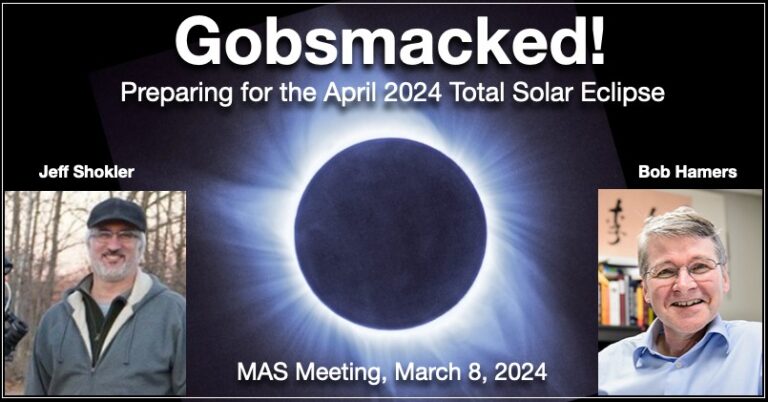
    Bob Hamers and Jeff Shokler will help you prepare for your total eclipse experience by sharing the insights, tips, and lessons learned from their own eclipse experiences. During the talk, they’ll help you consider your eclipse viewing and/or imaging goals, discuss the many ways one can enjoy experiencing a total solar eclipse (including the numerous phenomena to keep an eye out for), and share important safety considerations.

    If photographing the eclipse is one of your goals, they’ll also talk about the kinds of imaging gear that is most appropriate for photographing total eclipses, and how to plan and prepare for taking pictures – particularly under the demanding, tight timelines total eclipses present imagers. It’s not easy managing photographic gear while you’re totally gobsmacked by the sight of a total solar eclipse! Planning and preparation are the keys to success after your brain shuts down, and you’re witnessing one of nature’s most remarkable events!

    Bob Hamers is a spectroscopist and chemistry professor at UW-Madison. He has been a member of the MAS since 2017 and enjoys a mix of DSO, planetary, and solar imaging.

    Jeff Shokler is the Director for Technology and Assessment in the Office of Academic and Career Success at UW-Madison, serving in this role since November of 2012. Previously, he worked for fifteen years in the L&S Honors Program – nine as its Associate Director. His educational background is in anthropology, archaeology, and geoscience from Southern Methodist University in Dallas, TX, and the University of Wisconsin-Madison. A long-time amateur astronomer (dating back to his childhood in Texas) and now astrophotographer, Jeff joined MAS in 2004 and served for 15 years on its Board as President, Vice President, and Board Member-at-Large. He enjoys doing science and astronomy outreach at events like “Moon Over Monona Terrace,” star parties at Devil’s Lake State Park and Donald Park. Jeff often gives public presentations about astronomy and astrophotography at MAS monthly meetings, photography groups, school science classes, and senior living communities.

    Eclipse photo courtesy Jeff Shokler, August 2017.

    This meeting will take place in person at our usual Space Place classroom location. It will also be streamed live to our YouTube channel at https://www.youtube.com/@madisonastronomicalsociety.
  • Chasing ghost particles: searching for neutrinos from high-energy sources in real time.

    Friday February 9, 2024, 7:00pm – UW Space Place

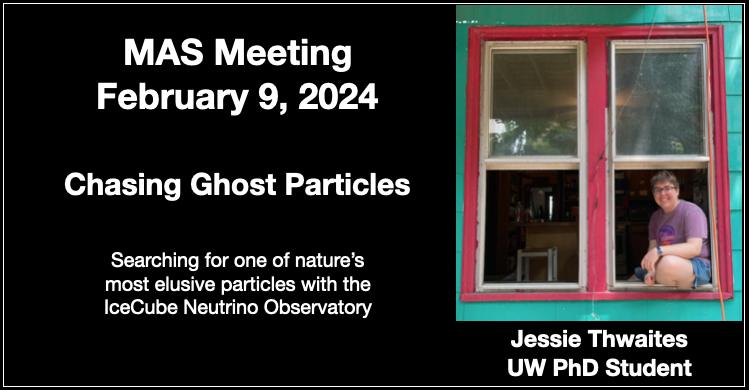
    Neutrinos are tiny, nearly massless particles that interact very rarely. Because of this, astrophysical neutrinos can travel very far, all the way to the South Pole, carrying information directly from their sources. The IceCube Neutrino Observatory has detected these astrophysical neutrinos, but only a few sources have been identified thus far. We search for these neutrinos from transient sources – sources that vary in their brightness over time, such as gamma-ray bursts (GRBs), supernovae, novae, or mergers of compact objects. These sources often have very energetic processes happening inside them to accelerate particles and produce these neutrinos. By searching for these transient sources as they’re happening (in real time), we can inform follow-up by other observatories also searching for them, and better understand the nature of some of the highest energy phenomena in our universe.

    Jessie Thwaites is a 4th year graduate student in the UW—Madison Physics department, working with Justin Vandenbroucke on the IceCube Neutrino Observatory. Their research focuses on searching for high energy astrophysical sources of neutrinos from transient sources, in both real time and archival data. In addition to research, Jessie writes for Astrobites, a daily science communication blog that summarizes astronomy or astrophysics papers into bite-sized pieces for the public. Outside of physics, Jessie plays horn and enjoys hanging out with their cat, Ryan.

    This meeting will take place in-person at our usual Space Place classroom location. It will also be streamed live to our YouTube channel at https://www.youtube.com/@madisonastronomicalsociety