BLOG HOME

Events

  • The Role of Oceans in Earth and Exoplanet Climates

    Friday July 11, 2025, 7:00pm – UW Space Place
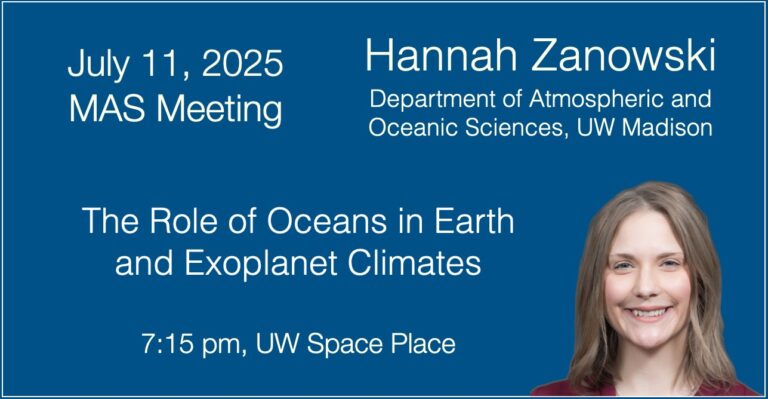
    Earth has had an ocean for more than 4 billion years. It likely formed sometime after the beginning of the Hadean Eon (4.6-4 billion years ago) via mantle degassing as the planet cooled. Although we know significantly more about the modern ocean than we do about its deepest past, an ever-growing body of research suggests that the key to understanding the origin and evolution of life on our planet, and perhaps planets elsewhere, may well be hidden in the ocean’s physical and chemical complexities. In this talk, I will give a broad overview of the fundamental role the ocean plays—and has played—in Earth’s history, from the evolution of early life to the climate we know today. In doing so, I will provide a crash course in physical oceanography, and I will draw from this body of knowledge, as well as recent research in my lab, to help us understand how oceans could behave on exoplanets, including their role in modulating climate and habitability.

    Dr. Hannah Zanowski is an assistant professor in the Department of Atmospheric and Oceanic Sciences (AOS) at UW-Madison. She earned her B.S. in physics and mathematics from the University of Arizona in 2011 and her Ph.D. in Atmospheric and Oceanic Sciences from Princeton University in late 2016. Zanowski uses climate models to do her research, which has three major focuses: present and future Arctic Ocean change, the physical oceanography of the Archean (4-2.5 billion years ago), and ocean circulation and heat transport on exoplanets. She is also the director of the STORM REU, a National Science Foundation (NSF)-funded undergraduate summer research program spearheaded by the AOS department in conjunction with the Center for Climatic Research (CCR), the Space Science and Engineering Center (SSEC) and the Cooperative Institute for Meteorological Satellite Studies (CIMSS). In her free time, Zanowski enjoys doing Muay Thai, spending time in the sun, and grossly overestimating how many native plants she really needs for her yard.

    This meeting will take place in person at our usual Space Place classroom location. It will also be streamed live to our Youtube channel at https://www.youtube.com/@madisonastronomicalsociety.
  • Hello world!

    Welcome to WordPress. This is your first post. Edit or delete it, then start writing!

  • Discovering Planets in the Solar System: The Search for Planet Nine

    Friday June 13, 2025, 7:00pm – UW Space Place

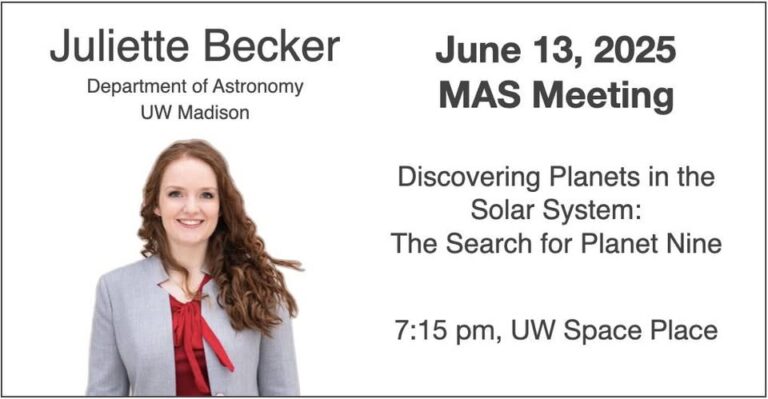
    UW Astronomy professor Juliette Becker will give a special presentation titled: Discovering Planets in the Solar System: The Search for Planet Nine

    In this talk, I will discuss the history of discovering planets in the solar system. After a brief historical context (on Uranus, Neptune, and Vulcan), I will discuss the current search for Planet Nine, the hypothetical as-yet-undiscovered ninth planet in our Solar System, thought to be about six times as massive as Earth and orbiting 600 times further away from the Sun than Earth does. I’ll discuss why scientists think it’s there, and what it might mean that no one has found it yet!

    Biography: I am a professor in the Department of Astronomy at the University of Wisconsin. My research interests include planet formation – understanding why planets form, and why planetary systems look the way they do. Previous to joining the faculty at Wisconsin, I worked at Caltech with Konstantin Batygin (the person who, along with Mike Brown, first proposed the existence of Planet Nine in 2016).

    This meeting will take place in-person at our usual Space Place classroom location. It will also be streamed live to our Youtube channel at https://www.youtube.com/@madisonastronomicalsociety.
  • Old Glass, New Tricks

    Friday May 9, 2025, 7:00pm – UW Space Place

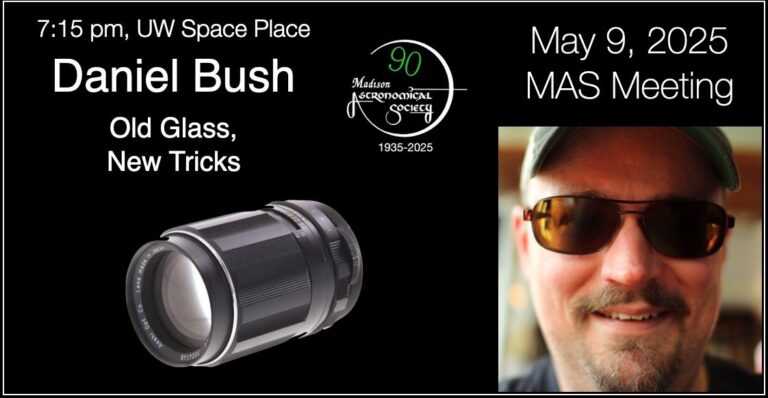
    Digital sensors and image processing software have revolutionized astronomy and astrophotography, but we still depend as much as Galileo on collecting photons. In our world of cooled cameras and image stacking, how much do we need the latest and greatest telescopes? MAS member Dan Bush will share his results from a recent experiment in combining new and old technology to image a familiar target, and perhaps spark some ideas about taking advantage of your older gear!

    Dan Bush is a recent astrophotography hobbyist and longtime astronomy enthusiast. Many years ago he was a physics/astronomy major, interning at the Space Telescope Science Institute and getting very sick on an observing trip to Kitt Peak. Eventually, his other interests and inability to grok differential equations led him down a different path. Dan lives on the Bortle 8 north side of Madison with his wife and 7th grader, whom he is dragging to Mount Palomar on their spring break trip to Southern California. He works as a Medicaid program manager for the Wisconsin Department of Health Services.

    This meeting will take place in-person at our usual Space Place classroom location. It will also be streamed live to our Youtube channel at https://www.youtube.com/@madisonastronomicalsociety.
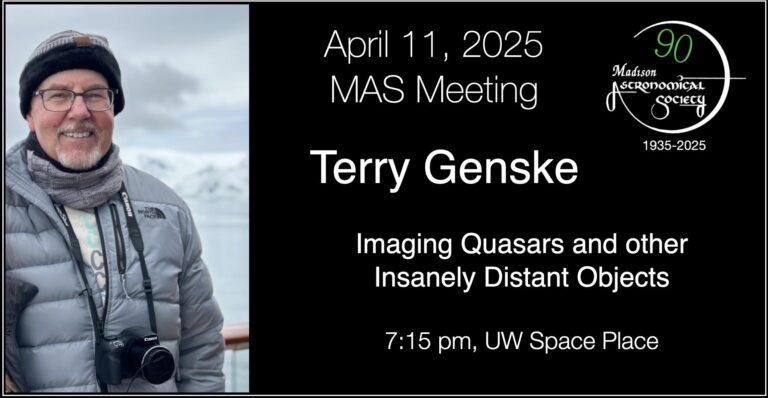
  • Imaging Quasars and Other Insanely Distant Objects

    Friday April 11, 2025, 7:00pm – UW Space Place

    Have you ever wondered what lies beyond the visible night sky? I want to take you on a tour of some of the more distant and enigmatic objects in the known universe including quasars, blazars, black holes, and other extreme objects. I will also discuss the equipment, process and challenges involved while attempting to image each of these objects.

    Bio: My name is Terry Genske. I am member of the Madison Astronomical Society (MAS) and more recently, the Astronomical League through MAS. My wife and I live in a condo on the north side of Waunakee, WI. I have always loved looking up at the night sky, but only recently entered the world of astrophotography. I quickly became hooked on the thrill of capturing beautiful night-sky images from our suburban driveway.

    This meeting will take place in-person at our usual Space Place classroom location. It will also be streamed live to our Youtube channel at https://www.youtube.com/@madisonastronomicalsociety.
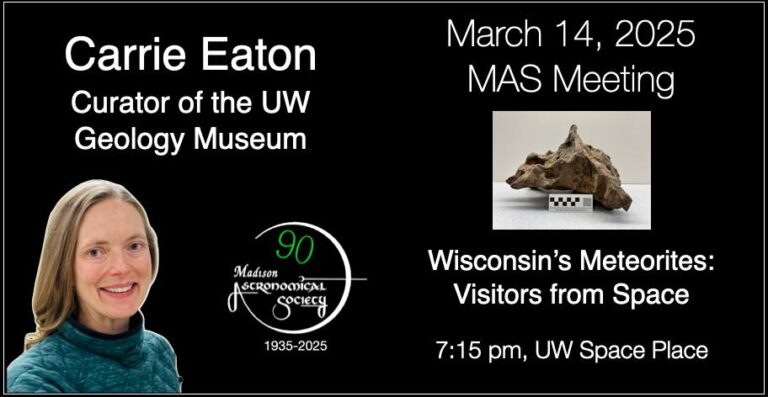
  • Wisconsin’s Meteorites: Visitors from Space

    Friday March 14, 2025, 7:00pm – UW Space Place

    Thousands of meteorites strike Earth’s surface each year, but most go unnoticed because they land in the ocean or in large, uninhabited areas of land. Wisconsin has only 15 known meteorite falls or finds, ranging from the Algoma meteorite recovered in 1887 to the witnessed fall of the Mifflin meteorite in 2010. Carrie will share the geological and historical stories behind some of these notable finds, as well as provide an update on the museum’s latest acquisition: the Vienna meteorite, Wisconsin’s 15th meteorite and Dane County’s first ever.

    Carrie Eaton has been the Curator of the UW Geology Museum since 2009. In addition to managing over 250,000 specimens in the museum collection, she curates and installs permanent and travelling exhibits, directs graduate and undergraduate students, and facilitates use of the museum’s permanent collection for research and education.

    This meeting will take place in-person at our usual Space Place classroom location. It will also be streamed live to our Youtube channel at https://www.youtube.com/@madisonastronomicalsociety

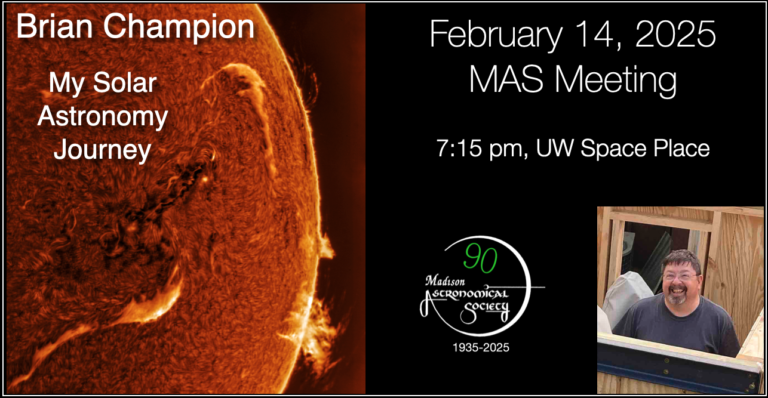
  • My Solar Astronomy Journey

    Friday February 14, 2025, 7:00pm – UW Space Place

    My interest in solar astronomy started when I got the opportunity to look through a solar hydrogen alpha telescope at the 2017 eclipse. I was captivated by what I could see on the Sun. In this discussion, I’ll go through how I started my solar astronomy journey, equipment I’ve used, things I’ve tried, custom equipment I’ve built, equipment I’m currently using, and processing techniques I’ve learned to create dramatic, high-resolution solar mosaic images. I’ll talk about how the Sun has changed over the last 7 years of my observations. The dramatic rise in solar activity in ’24 approaching solar maximum and what the next couple years may have in store. I’ll share images and stories of my eclipse experiences. I’ll welcome any questions you may have about the Sun.

    Brian Champion is a distinguished solar imaging expert and photographer based in Prairie du Chien, where he has been capturing stunning solar phenomena since 2017 from his backyard observatory. Using a 100mm Lunt Hydrogen Alpha telescope (656.28nm) and advanced filters like Calcium K and Solar Continuum, Brian brings the intricate structures of the Sun to life with unparalleled clarity and depth. His work has earned recognition within the astronomy community, with two of his images featured in Amateur Astronomy Magazine. Over the years, Brian has documented the last three solar eclipses visible from the United States, further showcasing his technical precision and artistic vision. In addition to his imaging achievements, Brian is deeply committed to fostering collaboration and education. He actively mentors others in the amateur astronomy community and participates in public solar outreach events at Wyalusing State Park, where he shares his expertise and passion for solar observation with audiences of all ages. Known for his approachable demeanor and dedication to innovation, Brian continues to inspire and elevate the field of solar imaging.

    PLEASE NOTE: Meeting changed to Zoom due to weather (see MAS member announcement for link and details).

    It will also be streamed live to our Youtube channel at https://www.youtube.com/@madisonastronomicalsociety.
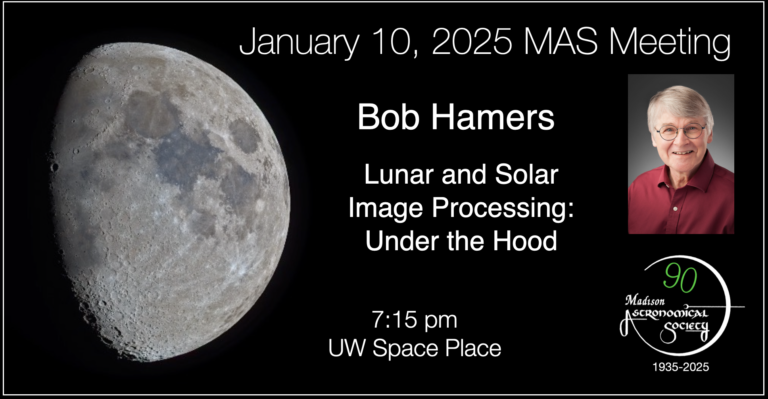
  • Lunar and Solar Image Processing: Under the Hood

    Friday January 10, 2025, 7:00pm – UW Space Place

    At the January 10, 2025 MAS meeting, member Bob Hamers will give a special talk titled:

    While commercial programs do a good job of processing most images. To get the very best result, it can be helpful to use additional tools to analyze, process, and visualize the process. In this talk, I’ll discuss some of the challenges of solar and lunar image processing and demonstrate some freeware tools that can be used to help get the most out of your data. As examples, I’ll walk through the processing of high-resolution, full-disc RGB imaging of the Moon and continuum imaging of the Sun, and I’ll briefly introduce the freeware tools ImageJ and Python.

    Bob Hamers is a UW-Madison Professor of Chemistry and MAS member. His UW research centers on chemical and structural analysis of solids and their surfaces. Bob’s astrophotography interests include solar, lunar, and DSO imaging. This meeting will take place in-person at our usual Space Place classroom location. It will also be streamed live to our Youtube channel at https://www.youtube.com/@madisonastronomicalsociety.
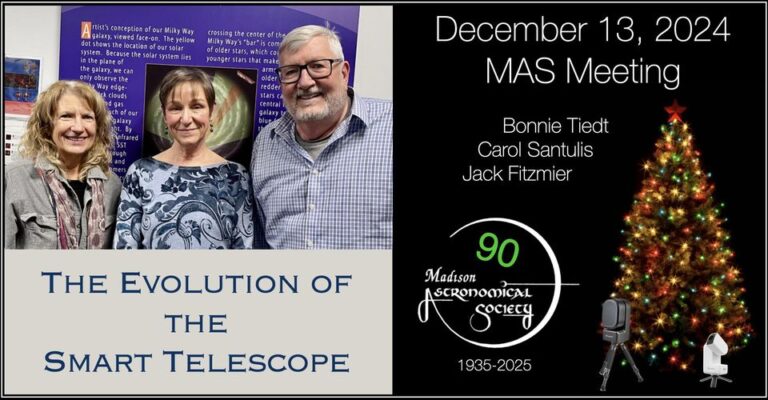
  • The Evolution of the Smart Telescope

    Friday December 13, 2024, 7:00pm – UW Space Place

    A special presentation by MAS members Jack Fitzmier, Bonnie Tiedt, and Carol Santulis.

    Recent smart telescopes are an evolutionary advancement in astrophotography yielding unprecedented ease of use. This is a three-part discussion about the advent and significance of the SeeStar technology among amateur astronomers. Jack will explore how new technologies have transformed amateur astronomy in the last 15 years, setting the stage for smart telescopes. Bonnie will discuss the SeeStar’s “out of the box” ease of use, and Carol will present more advanced aspects of the technology.

    This meeting doubles as our Solstice Celebration. Feel free to bring a holiday snack to share with the group. Cookies, brownies, or similar finger foods are preferred for minimal cleanup.

    This meeting will take place in-person at our usual Space Place classroom location. It will also be streamed live to our Youtube channel at https://www.youtube.com/@madisonastronomicalsociety.
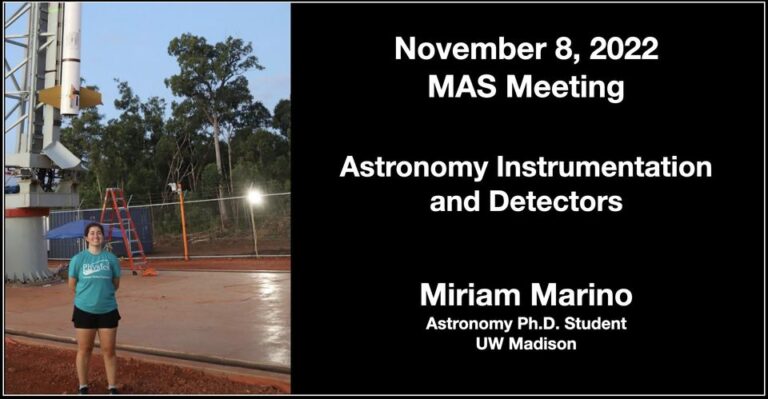
  • Astronomy Instrumentation and Detectors

    Friday November 8, 2024, 7:00pm – UW Space Place

    Description: Astronomers rely on scientific instruments to get good quality data to explore the unresolved questions about our universe. One way to get better data is to improve our scientific instrumentation. This is what makes new instruments like the James Webb Space Telescope so exciting. I will discuss some of the technological advancements in some popular science instruments and also talk about my research on next generation X-ray detectors.

    Bio: My name is Miriam Marino (she/her) and I am a third year PhD student at UW-Madison in the Astronomy department. I work in Professor Dan McCammon’s research group and my research focus on fabrication next generation high energy resolution X-ray detectors for space based applications. Outside of work I like to play ultimate frisbee, hike, run, bike and read.

    This meeting will take place in person at our usual Space Place classroom location. It will also be streamed live to our YouTube channel at https://www.youtube.com/@madisonastronomicalsociety.