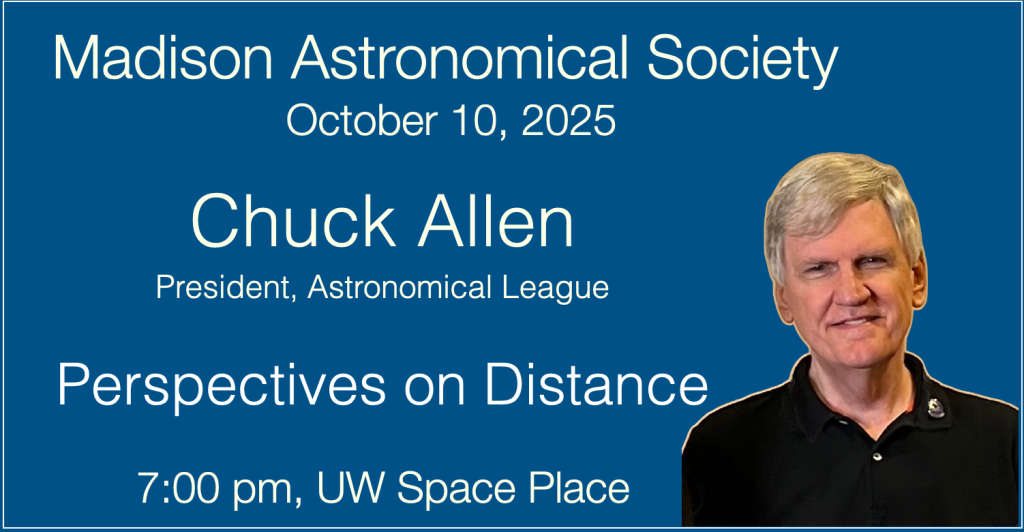
“Perspectives” examines relative distances in the universe and the possible distances achievable through manned and unmanned space flight and through amateur and professional telescopic observation. Examining scales from the human altitude record to the four cosmological horizons, the program discusses astrophysicists’ current thinking about several significant questions:
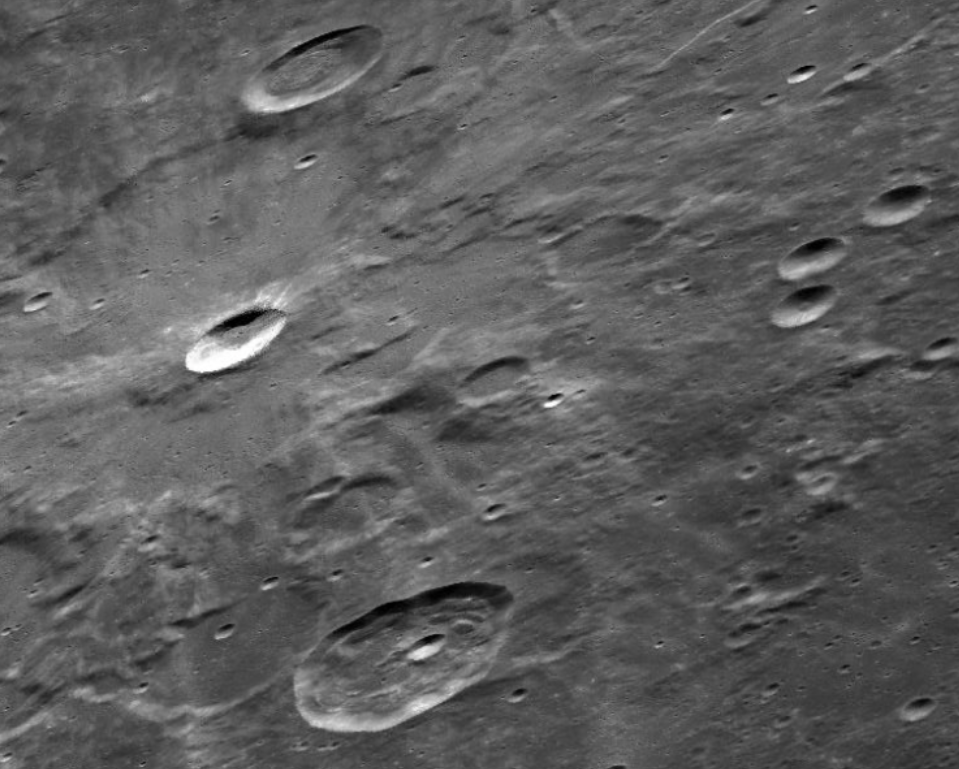
The LROC QuickMap is like a web-based virtual telescope that puts thousands of terabytes of lunar imagery at your fingertips. Its powerful interface makes browsing lunar images deceptively easy—and addicting.
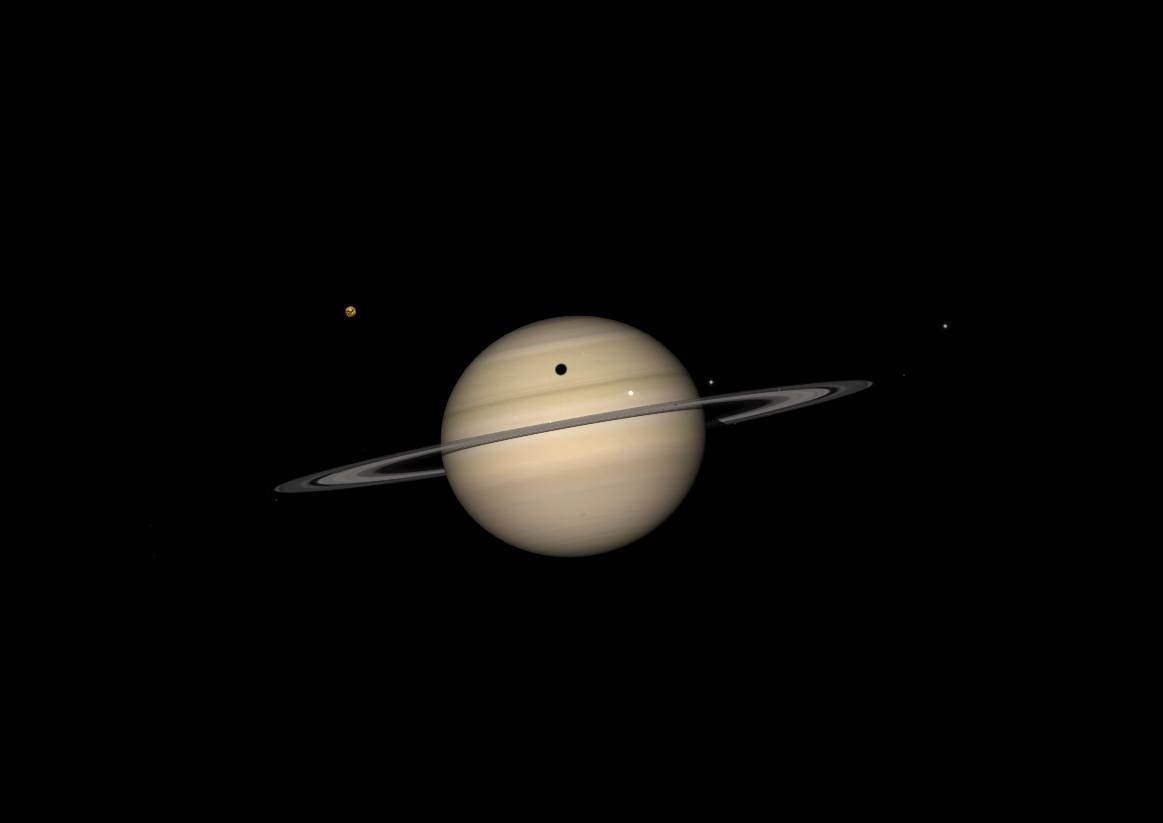
A simulation created using Starry Night Pro of Titan’s shadow transiting Saturn’s disk.
Twice during every 29.5 year orbital period of Saturn around the sun, Earth and Saturn briefly occupy the same ecliptic plane. During this brief period two rare planetary phenomena can be observed: Saturn’s rings will appear edge on, and Titan’s shadow may be seen transiting the disk of the planet.
We meet at UW Space Place, located in the Villager Mall (right behind the Goodman Library), two blocks north of the Beltline Highway at 2300 S. Park St., Madison. Space Place is located downstairs on the lower level of the Atrium. Elevators are on the left side as you enter the lobby. Space Place has a classroom setting for our meetings as well as a museum that highlights the UW’s role in space science and astronomy.
When does MAS meet?
Our regularly scheduled meetings are on the second Friday of every month at 7:00 PM. In addition, we schedule occasional star parties, outreach events, and special presentations that are open to the public.
What happens at MAS meetings?
Most meetings start with a newcomer orientation at 6:45, a social time from 7-7:15, announcements and welcome visitors at 7:15, and the main presentation at 7:30.
What are the presentations like?
Our presentations are of two main types: talks by our own members about the stuff we do (observing, photography, gear, etc.) and presentations by astronomers and other professionals (mostly from the UW Madison) about their research.
Are the meetings recorded?
Yes. Most of our meetings are streamed live to our YouTube Channel and archived there for later viewing.
Do I need any special knowledge to be a member?
Not at all. Our members are men, women, and young people of all ages, from all walks of life, with education levels from “barely made it through high school algebra” to advanced degrees. All you need is a curiosity about the universe and a desire to learn.
Are there any other MAS events to look out for?
In addition to the monthly meetings, MAS holds an annual picnic, usually in the fall. Prior to COVID we also held an annual banquet, usually in February or March (we’re hoping to resurrect that tradition in 2026). The picnic is always held at YRS, our dark sky site in Green County. The banquet is generally held at a local restaurant and usually includes an after-dinner talk by an invited guest. In addition to all this, MAS hosts a variety of observing events every year, both at our dark sky site as well as public events in parks, or larger events like the annual Moon Over Monona Terrace star party. Watch club announcements for upcoming events or drop us a line at madisonastro.info@gmail.com.
What is MAS’s address?
MAS’s mailing address is PO Box 5585, Madison, WI 53705.
As soon as MAS officially formed in early 1935, one of the first things its founders did was establish a newsletter. They recognized the significance of communication with members, the ability to share information, and the creation of a lasting record that would recount the group’s story to future generations. MAS is happy to continue this tradition today with the Capitol Skies. If you would like to be a contributor, contact editor Jack Fitzmier, atmadisonastro.info@gmail.com.
In 2024, the Madison Astronomical Society’s board of directors voted unanimously to rejoin the Astronomical League after an absence of nearly three decades. MAS members can now opt to join the AL when they renew their annual MAS membership or when they initially join the club. Happily, about 60 MAS members have added the AL to their MAS memberships to date.
If you have not yet browsed the AL website, we encourage you to do so at www.astroleague.org. There’s much to learn there. And there are many benefits to AL membership, too. These include:
The Reflector magazine is a quarterly publication that you will receive as part of your membership. It comes in hard copy by mail or in an electronic format. It includes astronomical news, previews of upcoming celestial events, how-to articles, and information about AL award programs.
The League coordinates around 70 observing programs designed for amateurs who want to take on more challenges with their visual observing or their astrophotography. Typically, a program requires the observer to view, image, or sketch about 100 targets of a particular kind. The observer keeps a log, submits it to a peer reviewer, and if it is found to be satisfactory, the observer is awarded a certificate of accomplishment and a lapel pin. There are programs for every skill level, from beginner to accomplished observer, and for every observing instrument, from the naked eye to scopes, binoculars, and sophisticated imaging equipment.
The League hosts excellent in-person and virtual meetings. MAS is part of the AL’s North Central Region. Our regional conference was held in the spring of 2025 in Minneapolis. The 2025 national gathering, called Al Con, was held in the summer of 2025 in Bryce Canyon, Utah. To keep updated on AL’s virtual meeting schedule, we suggest you join the Astronomical League’s Facebook page, where they announce their “Global Star Parties.”
The League also publishes helpful observing guides. Some are related to the observing programs, but they make excellent resources on their own. You can purchase them from the AL website (others are available gratis). And recently, the League has begun posting interesting observational materials every other day on its Facebook page. Useful material for personal use or for outreach!
Finally, please check out the AL’s online Store, where members can purchase observing materials, books, and all sorts of neat AL swag.
We hope that your experience with the Astronomical League will be rich and rewarding. If you have questions or comments about the AL or its programs, please feel free to contact our MAS/Astronomical League liaison, Jack Fitzmier, by sending a message to madisonastro.info@gmail.com.
Did you know…
MAS was a founder and charter member of the Astronomical League.
In January of 1936 the Madison Astronomical Society—not yet a year old—joined a brand new affiliation of astronomy clubs called the American Amateur Astronomical Association. The AAAA was founded in 1935 and was the brainchild of Edward Halbach of Milwaukee. Halbach is a legend in the world of amateur astronomy and had been instrumental in the founding of the Milwaukee Astronomical Society in 1932. Though it had the support of more than a dozen astronomy clubs at its peak in 1938, the AAAA proved to be untenable, or perhaps just ahead of its time. After 1938, it ceased activities.
The loose affiliation of astronomy clubs would continue to meet and organize for most of the next decade and at a Detroit meeting in 1946, the final plans for what would become the Astronomical League were in put in place. At a meeting in Philadelphia in July of 1947, the Astronomical League was officially launched.
The Madison society was involved from the very start. MAS members Harold Porterfield and Charles Huffer were instrumental in the formation of the North Central Region (NCRAL) and hosted the first NCRAL conference in Madison in 1949. It would host another in 1960, and Madison would go on to host no fewer than three national conventions (1954, 1978 and 1993). Many other MAS members served as delegates to the League over the years including the influential Paula Birner Carey, who helped found the MAS and would do the same for the Racine Astronomical Society in 1954. For nearly fifty years, MAS and the AL enjoyed a mutually beneficial relationship.
Unfortunately, by the 1990s, the relationship between MAS and the AL had begun to unravel. In 1993, the club hosted the AL’s national convention, which was widely regarded as a resounding success. However, this event marked the beginning of tensions between the two organizations. Although the exact nature of the conflict remains unclear, there were apparent disagreements regarding the convention’s format. MAS, as the host society, sought to break with tradition and adopt a workshop format instead of the traditional reading of papers. Additionally, there were apparent disagreements over the disbursement of profits. These issues led the board of MAS to vote the following fall to withdraw from the AL after nearly a half-century of association. The decision to leave was not without controversy. It required the concurrence of the general membership, and the board brought it up at three or four consecutive meetings before ultimately achieving a majority decision to sever the ties.
MAS is delighted to be back in the AL after so many years away, giving our current members a chance to avail themselves of League benefits and continue the tradition of collaboration.
(excerpted from an article in Northern Lights, the NCRAL quarterly newsletter, by John Rummel and Jack Fitzmier)
MAS holds monthly meetings at Space Place (2300 S. Park St, Madison). Along with the regular observing opportunities afforded by the group, these monthly meetings are probably the heart of the MAS experience for most people.
Our meetings should provide three core experiences for our members and visitors:
Opportunities to meet old and new friends, socialize, and converse about an area of interest we all share.
Occasion for members and visitors to ask questions and seek the advice of more experienced/knowledgable members, and,
MAS meetings are explicitly designed to expand our knowledge base and challenge us to learn new things about the hobby and the science that lies at the core of it.
All three of these areas are of equal importance. We select our monthly speakers because we think the talks are engaging and of wide interest. But we also begin each monthly meeting with an explicit “newcomers” roundtable designed to appeal to first- or second-time visitors who have basic questions or a desire to simply listen and determine if the group is right for them. We hope newcomers will feel welcomed and comfortable, and that they will find the meetings inviting in a way that draws them in.
MAS members at a monthly meeting in Space Place, August, 2024.
Members tend to be a social bunch and the unstructured segments of our meetings can be noisy and boisterous. We hope you are greeted by someone soon after arriving or that you feel comfortable approaching someone to introduce yourself!
Whatever your reason for visiting, we’re glad you’re here!