A survey of the history of ideas about the shape of the Earth in Western Civilization with a focus on the nineteenth century, which saw both the rise of the Warfare hypothesis (which encouraged secularists to misrepresent medieval ideas) and the rise of the modern Flat Earth movement, concluding with a glance at the present state of that movement.
About the Speaker:
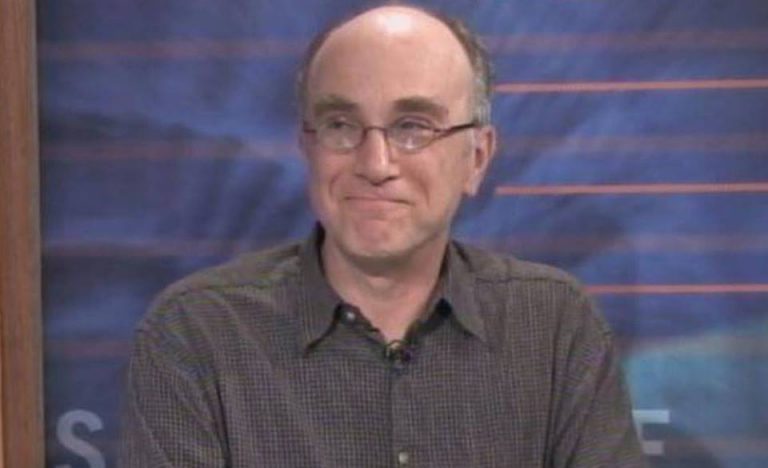
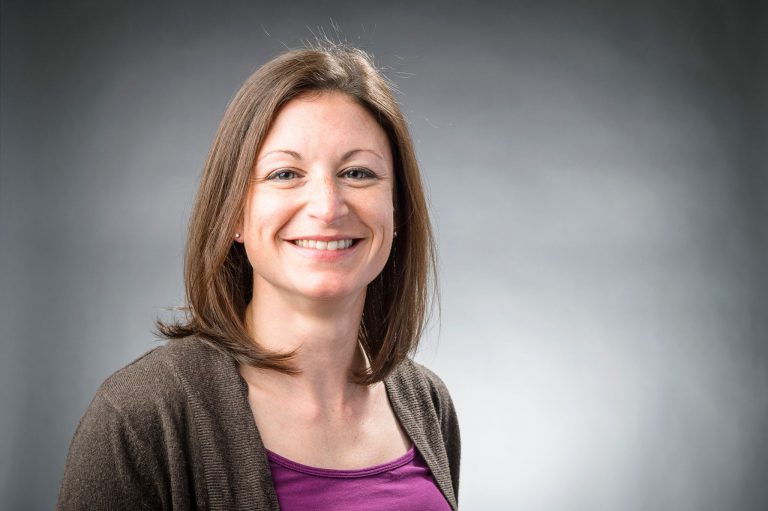
Peter Sobol has taught the history of science at Indiana University, Oklahoma University and the University of Wisconsin-Madison. in addition to standard history of science he has taught courses on the history of pseudoscience and the occult, hence his abiding if morbid interest in the vagaries of human thought.
the occult, hence his abiding if morbid interest in the vagaries of human thought.
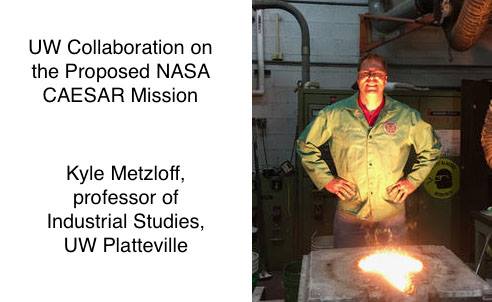
How did a 375 lb. iron weight cast by students at UW-Madison and UW-Platteville help the CAESAR Mission get off the ground and become one of two finalists in a NASA proposal? If selected, CAESAR, which stands for Comet Astrobiology Exploration Sample Return, would visit the Churyumov-Gerasimenko comet and collect a small sample of its surface material. Led by Dr. Steve Squyres, principal investigator on NASA’s Mars exploration rovers, the device could grab at least a 100-gram sample from the nucleus of the comet and deliver it back to Earth in capsules to help demonstrate how the same materials contributed to early Earth.
The UW project entailed designing a shaped weight that had a similar radius at the bottom as the capsule and the same mass. The return to earth will be without a parachute and will have a very large acceleration when it contacts the earth. The acceleration needed to be measured to help design the internal components to be strong enough for that impact. UW Students cast the test article with mounts for the accelerometers and even conducted some test drops in the UW Foundry Laboratory. Their project was done in secrecy as the initial competition for the NASA project is fierce therefore we had to remain quiet about this until the recent announcement of the finalists.
Dr. Larry Sromovsky UW-Madison Space Science and Engineering Center
Cassini observations show that Saturn’s polar regions contain giant cyclones and unusual cloud configurations, including dark eyes that bring to mind the eyes of earthly hurricanes. Both on Earth and on Saturn, these eyes are regions of reduced cloud cover resulting from descending motions. Cassini images of the south polar regions also showed that circular cloud bands at the edge of the eye cast very long shadows. This led to the conclusion that there were towering convective storms reaching into the stratosphere, producing eyewalls that were casting shadows, much like hurricanes on earth, but on a vastly larger scale. I will show that this conclusion is completely wrong, that it is inconsistent with other observations, and that the shadows themselves can be explained by a very different phenomenon.
The trail begins with spectral observations by the Visual and Infrared Mapping Spectrometer (VIMS). Fitting these observations with model clouds failed to confirm the presence of optically thick eyewalls. But how can shadows be produced without an eyewall? The answer is surprisingly simple, as I will show qualitatively by a simple physical model, and quantitatively with Monte Carlo calculations that were needed to deal with light scattering at discontinuous boundaries. The physical model and Monte Carlo calculations also show that something called antishadows should also be produced on Saturn, and they are in fact observed, further confirming the explanation.
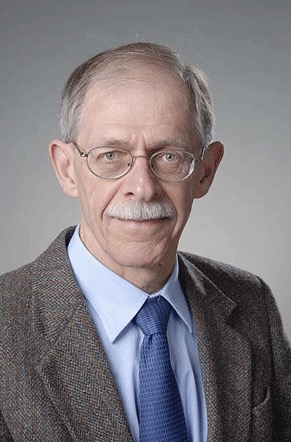
Dr. Larry Sromovsky is a Senior Scientist at the UW Madison’s Space Science and Engineering Center (SSEC). He was a co-investigator for Voyager Imaging Team support at SSEC through the Neptune encounter. He later served as principle investigator of the Galileo Net Flux Radiometer, which successfully probed Jupiter’s atmosphere in 1995. Since 1993 his research has focused primarily on dynamics and cloud structures of outer planet atmospheres, making use of spectral and imaging observations by Cassini and New Horizons space missions, the Hubble Space Telescope, and NASA’s IRTF, Gemini, and the Keck ground-based observatories. Dr. Sromovsky received his Ph.D. in physics from the UW Madison in 1970.
Friday, December 14, 7pm Space Place, 2300 S. Park St., Madison WI
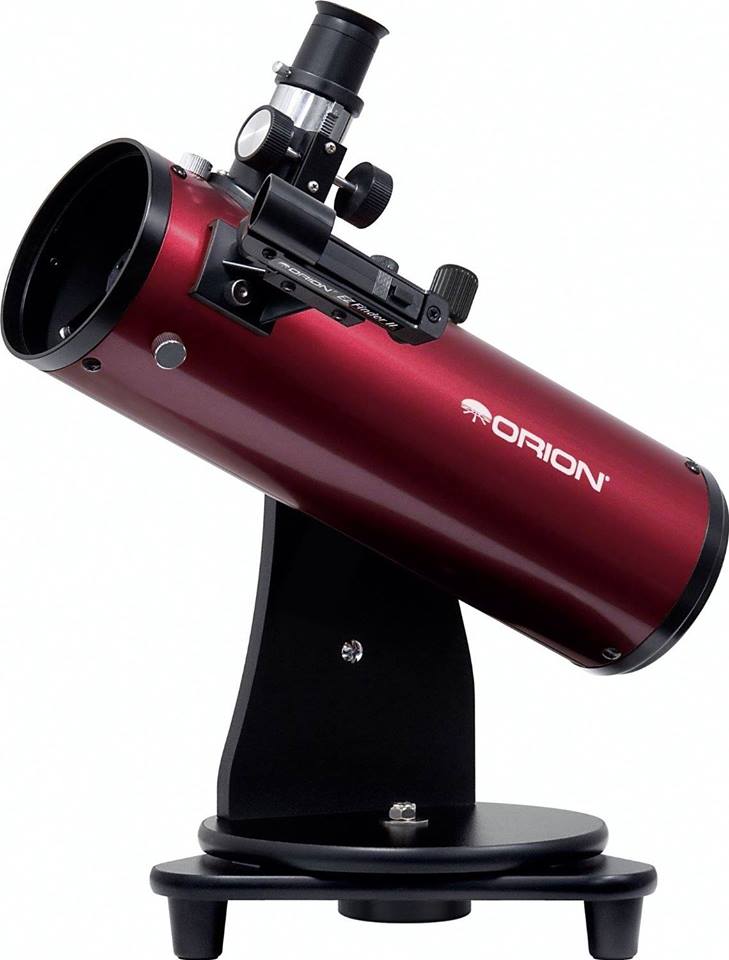
MAS’s annual telescope clinic is a chance for people in the Madison area to get their questions answered about telescopes and binoculars. It may also help you with some ideas for the gift-giving season.
Do you have an old telescope that’s gathering dust because you don’t know how to use it?
Maybe it’s broken or missing a piece.
Maybe you tried it last year and just couldn’t get it to work.
Whatever the case, come on out and learn something. MAS members will be on hand to look your scope over with you, diagnose any issues, and teach you how to use it if necessary. If you’re not a scope owner yet, you may walk away with some ideas. We’ll have a few popular types of telescopes on hand to serve as models.
This is also our annual solstice party, so feel free to bring a tray of cookies or other delicious holiday snack to share. See you Friday at Space Place, 2300 S. Park St, Madison, WI.
Kelly Tyrell, MAS guest speaker for the November 9, 2018 monthly meeting.
Topic: Has science lost the public trust?
Description: Some say astronomy is a “gateway science.” With compelling images, a long and storied history, and the power to spark curiosity, astronomy has often succeeded better than other sciences at capturing public attention. With news announcements like the first detection of high-energy neutrinos at IceCube and the audible “chirp” of gravitational waves from LIGO, the scientific community celebrates the opportunity to share with others the excitement of the field. Astronomy seems to have earned the public’s trust.
But we also live in an age where people dismiss information off-hand if it doesn’t fit their world view. Some despise expertise. Hosts of people deny the human causes of climate change, attribute childhood vaccines to unrelated conditions, and believe the Earth is flat. Meanwhile, political leaders appear to ignore scientific evidence and, in some cases, actively work against it.
Has science in general lost the public trust? If so, how can we earn it back?
Kelly Tyrrell is a scientist-turned-science writer at the University of Wisconsin–Madison with a BS in Zoology from the University of Florida and an MS in Cellular and Molecular Biology from UW–Madison. In 2011, she was a Mass Media Science and Engineering Fellow with the American Association for the Advancement of Science (AAAS), learning journalism – trial-by-fire – at the Chicago Tribune. Tyrrell has also worked as a health and science reporter for the News Journal in Wilmington, DE, and as a freelance writer for the Philadelphia Inquirer. In 2014, she joined the University Communications team at UW–Madison, where she covers research of all kinds. In 2018, she published an online storytelling project called Origins, which features a chapter on the Southern African Large Telescope. She considers it an immense privilege to have visited the largest optical telescope in the Southern Hemisphere.
Friday, April 28, 2017, 7:00-9:30pm (weather permitting) – Monona Terrace Convention Center
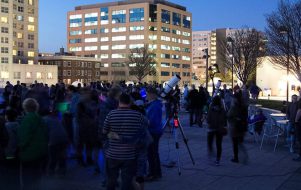
Join members of the Madison Astronomical Society (MAS) for the spring “Moon Over Monona Terrace” event on Friday, April 28, 2017 from 7:00-9:30pm (weather permitting)! We’ll have telescopes of all kinds set up on the rooftop and will be able to view the Moon, Saturn, Mars, galaxies, star clusters, and more! It is a family friendly event.
When? Friday, April 28 at 7:30 PM – 9:30 PM (weather permitting)
Where? Monona Terrace Community and Convention Center 1 John Nolen Dr, Monona, Wisconsin 53703
On Friday, April 14, 2017, 7:00 pm at UW Space Place, the MAS general meeting will feature a talk by Craig Deller on the Conservation of the Historic Dearborn Telescope.
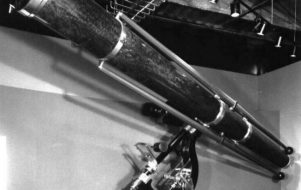
The Dearborn Telescope has been in the collection of the Adler Planetarium and Astronomy Museum since 1930. Considered the largest in the world when it was built, the telescope has significant historical importance to both Chicago and astronomy. This presentation will examine the telescope’s history, condition examination, and original surface recovery treatment.
Craig Deller is a Fellow of the American Institute for Conservation of Historic & Artistic Works and on the faculty of the School of the Art Institute of Chicago’s “Interior Surfaces Conservation Lab…