BLOG HOME

Events

  • Stellar spectroscopy and the formation of the chemical elements

    Friday August 12, 2022, 7:00pm – UW Space Place
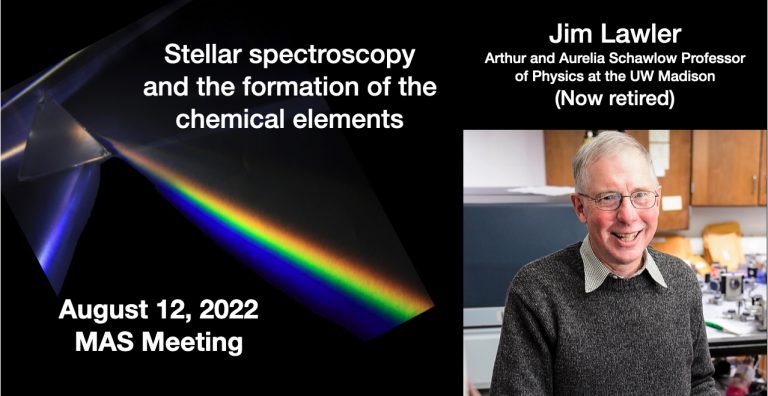
    Dr. Jim Lawler, UW Madison Dept of Physics, the Arthur and Aurelia Schawlow Professorship

    I will talk about how we measure spontaneous decay rates between two energy levels of an atom or ion, how stars produce spectra, and links between basic spectroscopy (like my group’s activities) and astronomy. Nearly everything humanity knows, or may every learn, about the detailed physics and chemistry of the remote Universe is from spectroscopy. I will mention the importance of quantization and the future of the quantum internet if time allows.

    Before retiring in May of this year, Jim Lawler was the Arthur and Aurelia Schawlow Professor of Physics at the UW Madison. Lawler spent his career in atomic, molecular & optical physics with a focus on developing and applying laser spectroscopic techniques to determine accurate absolute atomic transition probabilities.

    Lawler received his MS (’74) and PhD (’78) from this department, studying with now-professor emeritus Wilmer Anderson. In the two years after earning his doctorate, he was a research associate at Stanford University, and returned to UW–Madison as an assistant professor in 1980.

    Lawler has accumulated numerous awards and honors over his distinguished career. He is a fellow of the American Physical Society, the Optical Society of America, the U.K. Institute of Physics, and in 2020 he was elected a Legacy Fellow of the inaugural class of American Astronomical Society Fellows. He won the 1992 W. P. Allis Prize of the American Physical Society and the 1995 Penning Award from the International Union of Pure and Applied Physics for research in plasma physics, the two highest National and International Awards in the field of Low Temperature Plasma Physics. In 2017, he won Laboratory Astrophysics Prize of the American Astronomical Society for research in spectroscopy.

    The August MAS meeting live stream on YouTube has been scheduled. If you haven’t done so, go to the Madison Astronomical Society YouTube channel and click on the subscribe button. If you watch any of the MAS videos please click on the “Thumbs up” button. It helps to make the channel more visible to others on YouTube.
  • The Magellanic Stream: A Case Study in Interacting Galaxies

    Friday July 8, 2022, 7:00pm – UW Space Place

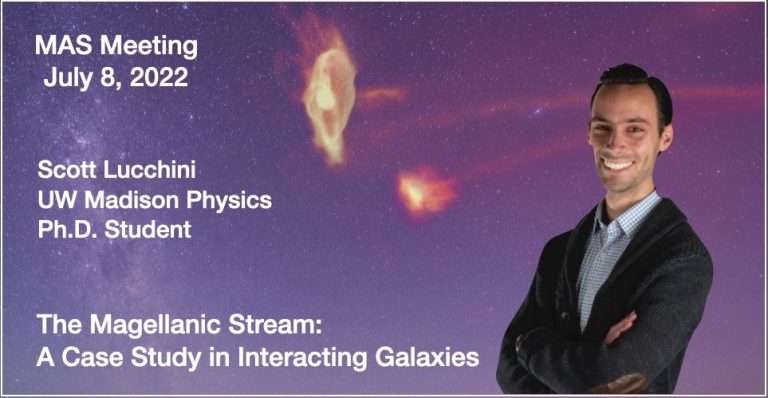
    Two of the Milky Way’s nearest neighbors, the Large and Small Magellanic Clouds, have been dancing around each other for billions of years. This dance has led to a huge amount of gas getting thrown from their disks and out into what we know as the Magellanic Stream. In my work, I run high resolution simulations of these interactions to better constrain the history and future of the Magellanic System. Some of our recent results have shown that a warm circumgalactic medium of warm gas around the Magellanic Clouds may play a large role in the formation and current properties of the Stream and that the Stream may be up to five times closer than previously thought. In this talk I will discuss these simulations and their development as well as their predictions and how we may be able to confirm or refute them in future work.

    Scott Lucchini is a PhD student working with Elena D’Onghia on hydrodynamic simulations of galaxy interactions. He is specifically studying the history and formation of the Magellanic Stream through tidal interactions between the Large and Small Magellanic Clouds. In his spare time he enjoys swing dancing, driving and working on his 1995 Mazda Miata, and landscape and architectural photography.

    This meeting is planned to be in-person at UW Space Place. We will make arrangements for people who can’t attend to stream the event live.

  • Doing Research with the Tianlai Array in Xinjiang, China

    Friday June 10, 2022, 7:00pm – UW Space Place

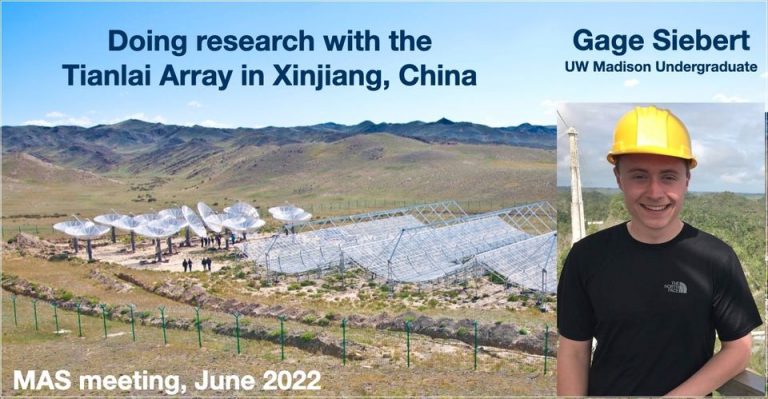
    UW undergraduate astronomy student Gage Siebert will present a talk on his research in radio astronomy:

    The Tianlai radio telescope array is one of several experiments working to map hydrogen density over large volumes of the universe. I’ll talk a little about how I came to work on Tianlai and describe how the experiment works. Then, we’ll talk about how these measurements relate to the earliest times in the universe and what they can teach us about the expansion of the universe and dark energy. Finally, I will describe how Tianlai is also used to search for extraterrestrial intelligence.

    Gage Siebert graduated from UW Madison in May of this year with his bachelor’s degree and will be attending Arizona State University for graduate school beginning in the fall of 2022.

    This meeting will be held on-line via Zoom.

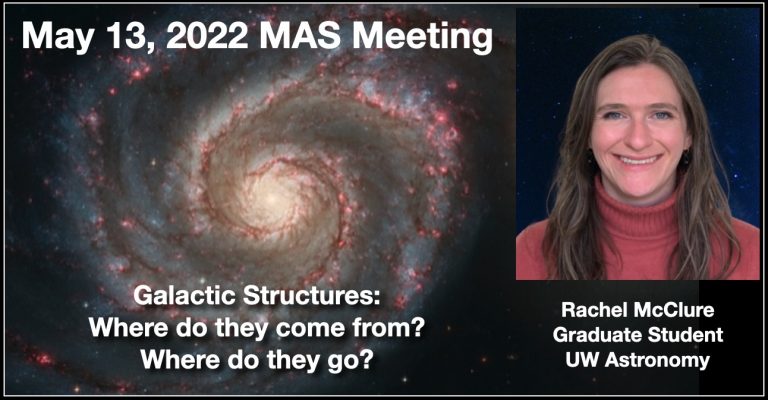
  • Galactic Structures: Where do they come from? Where do they go?

    Friday May 13, 2022, 7:00pm – UW Space Place

    Our observations of galaxies, from nearby to the edges of the observable universe, reveal striking diversity of size, environment, composition, and apparent structure. Ranging from the clumpy irregulars, through the massive round ellipticals, to the coherent disks — probing the mechanisms responsible for these formations in nature requires a wide range of investigative tools from theoretical observations to detailed spectroscopic observations. Barred spirals comprise >50% of the observed population of nearby disk galaxies yet the physical mechanisms that create and sustain these features are not well understood despite persistent study for nearly 200 years. In this talk, we will take a tour through the features that populate our local galaxies, explore their dynamical origins, and dive into some forthcoming results on bar supporting orbital populations.


    Rachel Lee McClure is a National Research Foundation Graduate Research Fellow in the third year of her PhD at the UW — Madison Astronomy Department in the MadAstroDynamics Group. Her research is an exploration of the formation and maintenance of bars in disk galaxies throughout the universe in collaboration with advisor Prof. Elena D’Onghia. Through her work, McClure characterizes the orbital dynamics of individual stars in large particle number simulations of galaxies to identify observable signatures for investigation with spatially resolved observational surveys of galaxies. Besides research, she is a passionate and dedicated educator focused on building inquiry-based structures into accessible astronomy coursework at the high-school and university level.


    This MAS meeting will mark our return to IN-PERSON MEETINGS at Space Place.

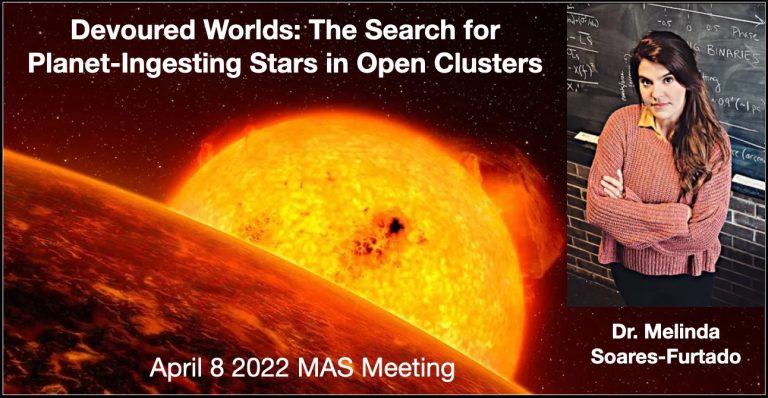
  • Devoured Worlds: The Search for Planet-Ingesting Stars in Open Clusters

    Friday April 8, 2022, 7:00pm – UW Space Place

    Melinda Soares-Furtado will talk about the observational signatures that are left behind when stars consume their own close-orbiting planetary companions, the ways in which we are searching for these events, and why finding cannibal stars in open clusters is of critical importance to our understanding of stellar and planetary astrophysics.

    Dr. Melinda Soares-Furtado is a NASA Hubble Postdoctoral Fellow at the University of Wisconsin-Madison. She has a BS in Physics from the University of California, Santa Cruz, and a Ph.D. in Astrophysical Science from Princeton University. She works on detecting and characterizing stars in open clusters that have anomalous characteristics brought about by the ingestion of close-orbiting substellar companions.

    This MAS meeting will be held online via Zoom.

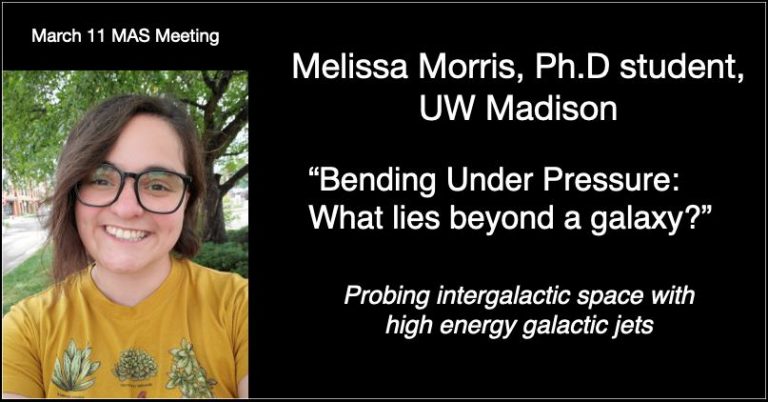
  • Bending Under Pressure: What Lies Beyond a Galaxy

    Friday March 11, 2022, 7:00pm – UW Space Place

    Cosmology tells us that roughly only 5% of matter in the universe is made up of normal atoms and matter that we’re familiar with. However, when astronomers try to take account of the matter they can see inside of galaxies, they find something puzzling – some of it is missing! So, where could it possibly be? It turns out there’s a good chance that it’s not inside of galaxies at all, but completely outside of them in a hard-to-observe gaseous state. When there are thousands of galaxies clustered together, this gaseous medium gets hot enough for us to see it at X-ray wavelengths, but in smaller groups of galaxies (typically 10s of galaxies), it is still difficult to observe and account for. While we can’t see the gas directly, we can see the effect it has on galaxies embedded in it. For example, high energy jets formed by active supermassive black holes at the centers of galaxies are typically very narrow and straight. However, when in galaxy groups, we can see the jets being bent back as the galaxy moves through the gas, similar to how a car’s antenna bends back when you’re driving on the highway. For my thesis work, I am using these peculiar bent jets to learn just how much gas exists in galaxy groups and how it can affect how these galaxies evolve.

    Melissa is a 4th year graduate student at the University of Wisconsin-Madison working with Eric Wilcots. Most of her research involves observations of galaxies at radio wavelengths to learn about their environments and how they change and evolve over time. On top of research, She’s also very passionate about teaching, mentoring, and outreach. She thinks it’s important to share science with as many people as possible to help improve science literacy (also because space is cool and she wants to make sure everybody knows it). Every now and then, you can hear her talking about fun astronomy discoveries on Radio Astronomy, a weekly short segment on WORT 89.9FM that airs on Tuesdays! Outside of grad school, she enjoys kayaking, video games, and going on adventures with her 10 year old lab!

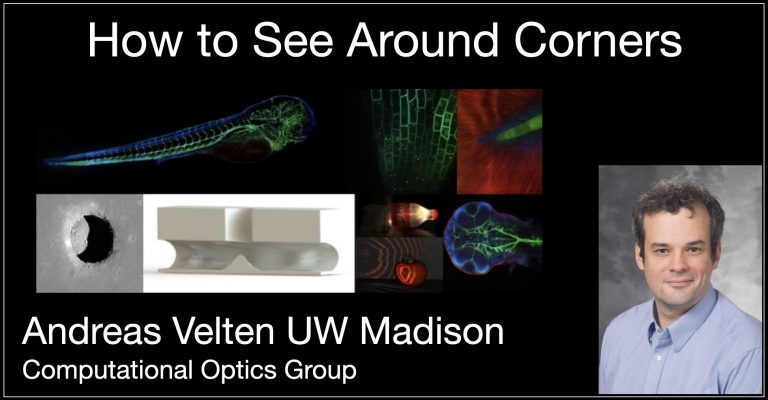
  • How to See Around Corners

    Friday February 11, 2022, 7:00pm – UW Space Place

    The light collected by a camera consists of multiple components: The direct component of light that traveled directly from a surface in the scene to the camera and many multibounce components made up of light that has been reflected more than once within the scene. The direct component carries the information about things in the line of sight of the camera. It is used to form a normal camera image. The multibounce components contain additional information about other objects that the light reflected off on it’s path from a light source to the camera.

    Non-Line-of-Sight (NLOS) Imaging systems reconstruct images of scenes using this indirect light from reflections off a diffuse relay surface, like a wall or the ground. After illuminating the relay surface with short pulses, the returning light is detected with single photon cameras that have enough time resolution to resolve the motion of light. We thereby capture video of the light propagation in the visible scene and reconstruct images of hidden parts of the scene.

    This method has potential practical applications for imaging into caves, assessment of infrastructure like buildings from the air, scouting of caves for potential human habitation on moon and mars, collision avoidance, robot navigation and path planning, as well as disaster response, military reconnaissance , and law enforcement.

    Andreas Velten is Assistant Professor at the Department of Biostatistics and Medical Informatics and the department of Electrical and Computer Engineering at the University of Wisconsin-Madison and directs the Computational Optics Group. He obtained his PhD with Prof. Jean-Claude Diels in Physics at the University of New Mexico in Albuquerque and was a postdoctoral associate of the Camera Culture Group at the MIT Media Lab. He has included in the MIT TR35 list of the world’s top innovators under the age of 35 and is a senior member of NAI, OSA, and SPIE as well as a member of Sigma Xi. He is co-Founder of Onlume, a company that develops surgical imaging systems, and Ubicept, a company developing single photon imaging solutions.

    The zoom link to the meeting will be sent to members a few days prior to the event.

  • IceCube Computing Systems

    Friday January 14, 2022, 7:00pm – UW Space Place

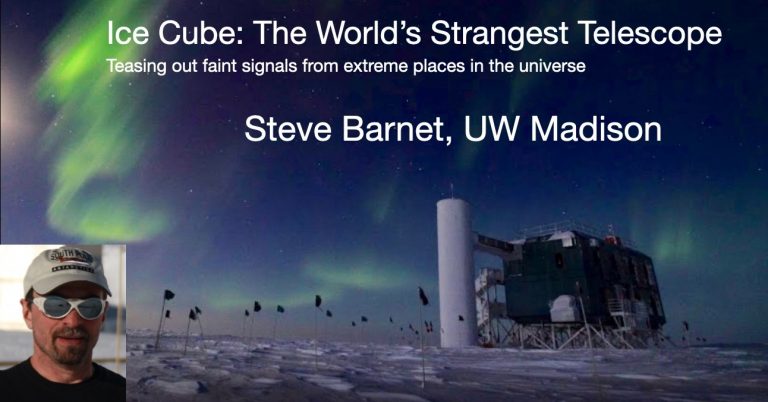
    Science is heavy! Teasing out faint signals from the most remote and extreme places in the universe is challenging scientifically, and technically. It takes tons (literally) of data storage, and a lot of computational capacity to collect and sift through the data looking for interesting signals. Steve Barnet has worked on the computing and data collection systems for the IceCube Neutrino Observatory for over 15 years. In this talk, he will provide a behind-the-scenes look at the computing systems powering one of the most unique instruments ever built.

    Steve Barnet earned his B.Sc. in Computer Science from the University of Wisconsin-Eau Claire in 1994. After a brief stint with Cray Research, he worked for several academic and research units at UW-Madison before landing at the IceCube project. There he manages the talented team that provides the infrastructure powering the IceCube Scientific Collaboration.

    Due to the continuing high levels of infection and hospitalization rate due to COVID-19, MAS HAS MADE THE DECISION TO REMAIN VIRTUAL FOR OUR JANUARY MEETING. The meeting will be hosted with Zoom as before. MEMBERS WILL RECEIVE AN EMAIL WITH LINKS AND INSTRUCTIONS a day or so before the event. Again, this month we are opening the virtual meeting up to our web followers who may want to join in. If you would like to attend the MAS virtual meeting, send an email to madisonastro.info@gmail.com by noon Friday, January 14th to let us know of your interest. We will email you the instructions and link by 3pm that day which will get you into the meeting by 7:30 on Friday evening.

  • Telescope Buying Clinic

    Friday December 10, 2021, 7:00pm – UW Space Place

    If it’s December, it’s time for the telescope clinic. Gift-giving season means you may be on the giving or receiving end of a telescope gift soon. Let’s make sure you can avoid the most common mistakes when purchasing a telescope.

    We’ve been doing this event for years, usually live. This meeting will be our second consecutive virtual version of the telescope clinic. We’ll do our best to share the critical info with you, and then allow plenty of time for questions and answers.

    We hope you can join us!

  • Adventures in Science Outreach: From Comets to Star Gazing and Everything In Between

    Friday November 12, 2021, 7:00pm – UW Space Place

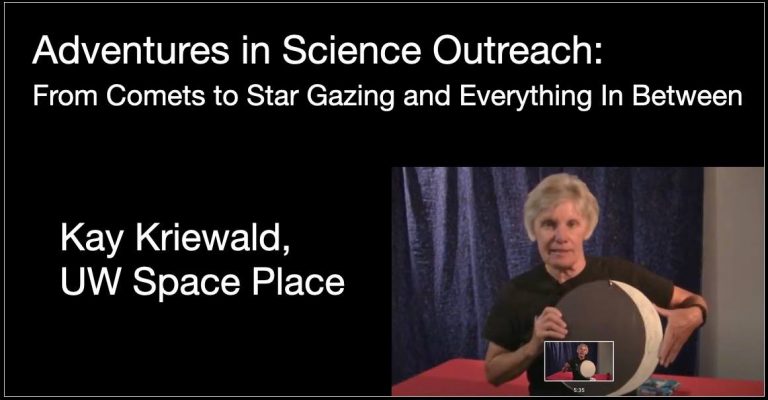
    Whether you are speaking to a third grader or an adult, understanding science can be easy when the ideas are communicated effectively. I will give a brief history of my time as outreach specialist with the UW Space Place and explain why I think outreach is a vital part of the UW’s mission. I will then list the top ten things I have learned over the past 20+ years about presenting science to the general public.

    Kay Kriewald has a background in teaching and tutoring elementary and middle school students in science and math. She has been an outreach specialist at Space Place since 1995. She hopes to retire soon but she is still having too much fun.

    Due to the continuing high levels of infection and hospitalization rate due to COVID-19 Delta, MAS HAS MADE THE DECISION TO STAY VIRTUAL FOR OUR NOVEMBER MEETING. The November meeting will be hosted with Zoom as before. MEMBERS WILL RECEIVE AN EMAIL WITH LINKS AND INSTRUCTIONS a day or so before the event. Again this month we are opening the virtual meeting up to our web followers who may want to join in. If you would like to attend the MAS virtual meeting, send an email to madisonastro.info@gmail.com by noon Friday, November 12 to let us know of your interest. We will email you the instructions and link by 3pm that day which will get you into the meeting by 7:30 on Friday evening.