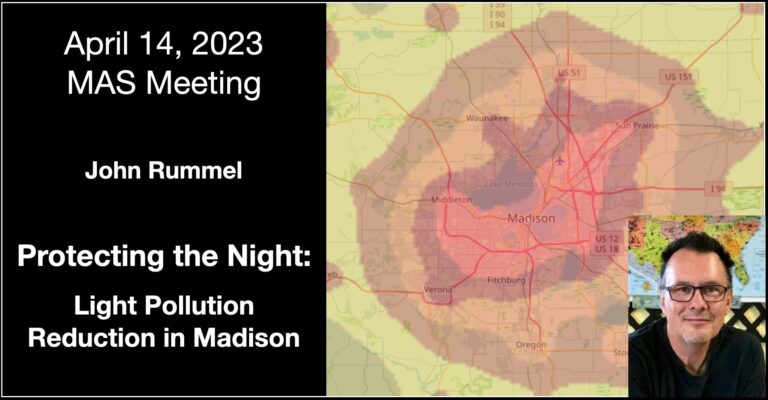
Could Madison WI be a dark sky community? The Common Council seems to think so and has taken action to this end. This talk will focus mainly on the problem of light pollution generally, how Madison is faring specifically, what the future may hold if we do nothing, and will end with the Common Council’s recent action, and why this is reason for us all to hope.
John is a long-time member and former president of the MAS and has recently taken an active role in advocacy of dark skies and adoption of smart lighting choices in places like Madison.
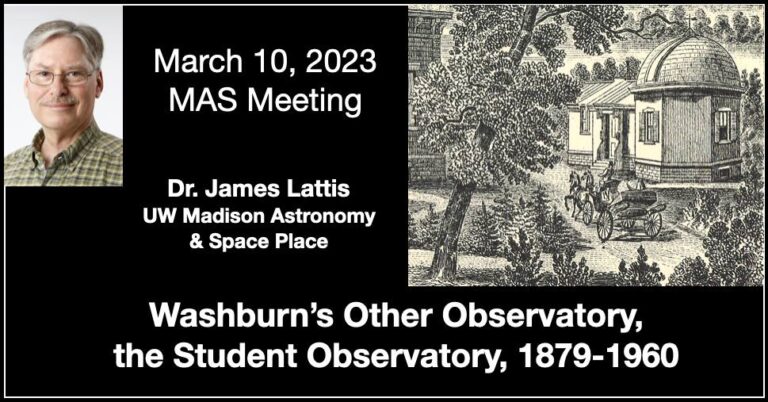
This talk will consider the origins and history of the UW Student Observatory, the telescopes it has been home to, and the scientific research carried out there up until its removal from the UW campus in 1960.
Jim Lattis is director of UW Space Place and Faculty Associate in the UW-Madison Astronomy Dept. Lattis is a historian of astronomy with specialties and publications in several areas including astronomy in the age of Galileo, astronomy in Italy, and astronomy in Wisconsin. Lattis also teaches introductory astronomy courses, including a course on the History of Astronomy and Cosmology. He holds a PhD in History of Science from UW-Madison.
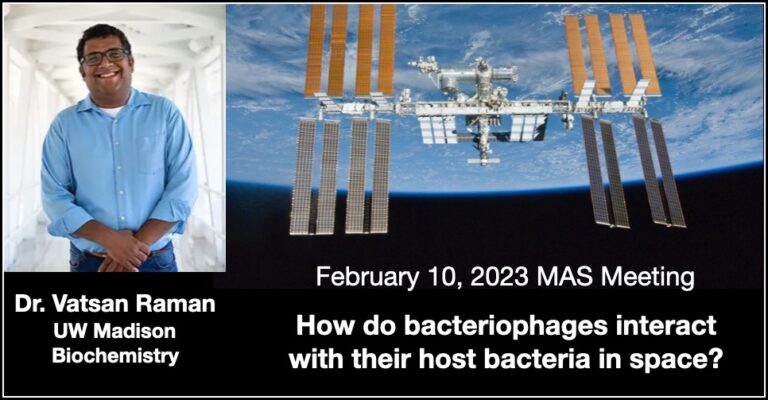
Bacteriophages, or ‘phages’, are bacterial viruses that are the most abundant organism on Earth. While phage research has progressed considerably terrestrially, how phages and bacteria interact in microgravity is largely unknown. Microgravity presents enormous challenge for microorganisms, which are greatly affected by gravity to mediate cell-cell and cell-phage interactions. To elucidate these interactions, we explore how T7 bacteriophage interacts with E. coli BL21 in microgravity onboard the International Space Station (ISS). We incubated samples in gravity and microgravity for short- and long-term experiments, finding that lysis is delayed in microgravity conditions and suggesting this phage is inhibited in microgravity. We identified novel mutations in phage proteins that influence activity in microgravity using whole genome sequencing and examine how microgravity influences selection in phage structural proteins. Our study provides a preliminary examination of the influence of microgravity on phage-host interactions. The success of the approach used in this study provides a foundation for future research in microgravity to explore interactions between phages and bacteria that define microbial communities.
Biographical sketch: Vatsan Raman is an Associate Professor in the Department of Biochemistry at the University of Wisconsin Madison. He is an affiliate in the Departments of Bacteriology, and Chemical and Biological Engineering. His research group aims to develop technologies at the intersection of biochemistry, microbiology, computation, and engineering to understand the fundamental principles of biomolecular and cellular systems. Before joining the UW-Madison, he was a Wyss Technology Development Fellow at the Harvard Medical School where he developed foundational technologies to engineer microbes using biosensors to sustainably produce fuels and chemicals. In his graduate work, he developed computational methods in the Rosetta biomolecular modeling software suite for predicting protein structures at atomic-level accuracy at the University of Washington, Seattle.
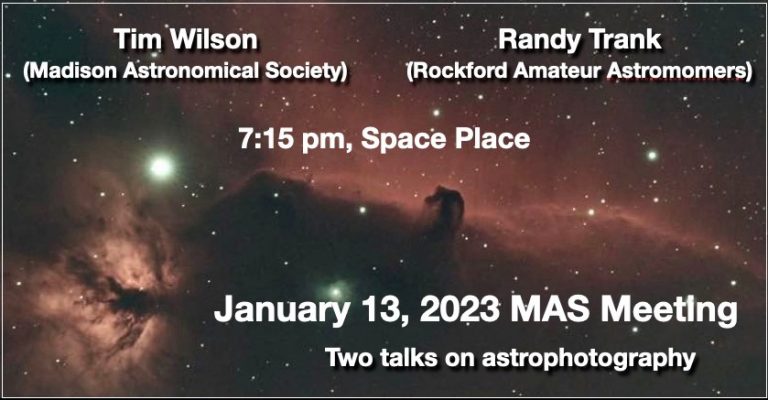
The January MAS meeting will feature a focus on astrophotography with presentations by two experienced practitioners:
Randy Trank on “Lucky Imaging and the Moon”
“Lucky Imaging” is a phrase used for certain types of astrophotography so I’ll explain that and show an example by processing a lunar photo.
Randy’s background: Randy became interested in astronomy under the dark skies of Lake Ripley when he was 12 with an Edmund Scientific scope. He loved the Apollo missions. Randy has dabbled in astrophotography for 50 years, avoiding the moon. He is now returning to his lunar roots and wishing he hadn’t avoided the moon for so long! Randy is a member of the Rockford Amateur Astronomers.
Tim Wilson on “Data collection, Organization, and Preprocessing”
Tim will cover: Light Frames: Inspection for bad images, planes, satellites, movement of mount, Dark Frames: Same temperature and Exposure Time, Flat Frames: Different methods, White Screen or T-Shirt Method, also touch on flat frames acquisition by using APT or SGP software, Bias Frames, Deep Sky Stacker: Loading files, basic settings, registration, image scores and stacking.
Tim’s background: Tim is a retired CNC and Manual Machinist; retired in 2016 from the Savannah Company in Waunakee, WI. Tim has done visual astronomy for the las 40 years, but finally tried his hand at astrophotography in 2014 and has been doing it ever since. Some of his other interests are Electronics, 3D Printing, CNC Router, CO2 laser cutting and Guitar. He has a love of science and technology and enjoys reading books on physics and astronomy. Tim is a long-time member of the MAS.
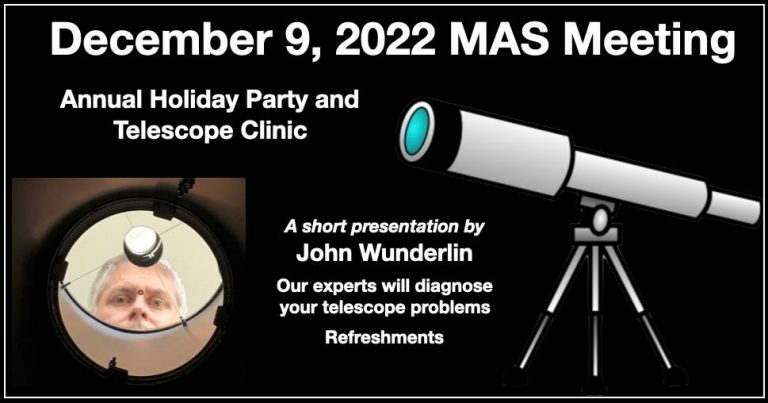
The return of the Madison Astronomical Society’s annual Holiday Party and Telescope Clinic.
Do you have a telescope that’s giving you problems? Has it been gathering dust in your closet instead of giving great views of the moon and planets? Are you stuck and can’t get to the next step? Our experts can help you diagnose the issues and get it figured out. Bring your telescope to this meeting and we’ll take a look at it with you.
Also, feel free to bring a holiday snack to share with the group. Cookies, brownies or other finger foods preferred.
There will be a short presentation by John Wunderlin, co-founder of the Iowa County Astronomers:
Title: So You Want To Buy a Telescope?
John will share his thoughts on telescope gear after almost 20 years in the hobby
John Wunderlin has been an active amateur astronomer for nearly 20 years. He co-founded the Iowa County Astronomers club in Dodgeville, Wisconsin and estimates that more than 5000 people have looked through his telescopes at outreach events over the years. He was an avid astrophotographer spending every clear night in his backyard observatory for a decade but since moving to Madison in 2014 has mostly stuck to weekend visual excursions with his 10″ Dobsonian. John founded his Spike-a.com astronomy business bringing the first commercial Bahtinov focusing masks and other astrophotography gear to the public in 2008.
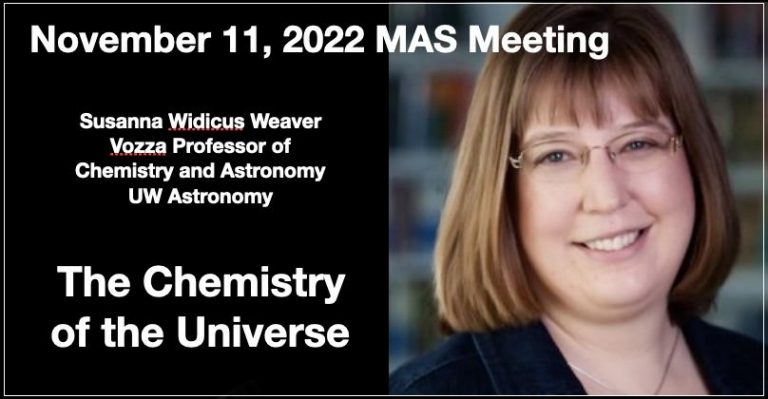
Summary: Molecules make up the world around us and serve as the building blocks to life as we know it on Earth. The questions remain as to how these molecules form and are incorporated into planets, and whether life might form elsewhere in the universe. Astrochemists study the chemistry of space and the evolution of molecules as stars and planets form. In this talk, I will overview my astrochemistry research program that incorporates laboratory spectroscopy, observational astronomy, and astrochemical modeling to decipher the chemistry that might lead to life in the universe.
Susanna Widicus Weaver, Vozza Professor of Chemistry and Astronomy at the University of Wisconsin is an expert in prebiotic astrochemistry. Her research, combining laboratory spectroscopy, observational astronomy, and chemical modeling, is aimed at understanding the mechanisms driving interstellar chemistry and the pathways for the formation of life. She received a bachelor’s degree in chemistry at Illinois Wesleyan University (2000) and her Ph.D. in chemistry at Caltech (2005). She was a postdoctoral fellow in Chemistry and Astronomy at the University of Illinois from 2005-2008. Before moving to Wisconsin, she was a Professor of Chemistry at Emory University. She is a passionate teacher and leads an active and diverse research group involving many students (https://widicusweaver.chem.wisc.edu).
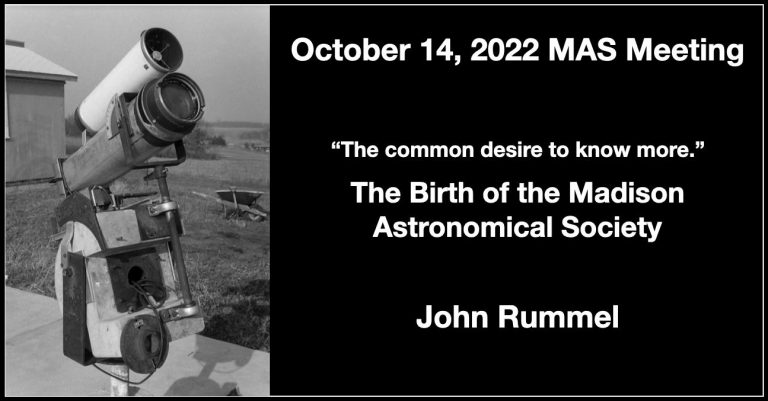
A presentation by John Rummel. In the mid-1930s, as the Great Depression continued to ravage the nation, group of Madison men and women came together around their common interest in astronomy and formed a club. Remarkably, almost 90 years later, today’s MAS still bears a striking resemblance to the original group as it took its first steps. This presentation will introduce a few of those founders and share a few of the stories that have come to light after lying forgotten for decades.
This meeting of the Madison Astronomical Society will be presented both live in-person at Space Place and online via YouYube. To watch online, visit our YouTube channel.
FREE ticket required for admission. Tickets are required for all attendees; subject to venue capacity and are issued on a first come first serve basis. There is a limit of 8 tickets per patron.
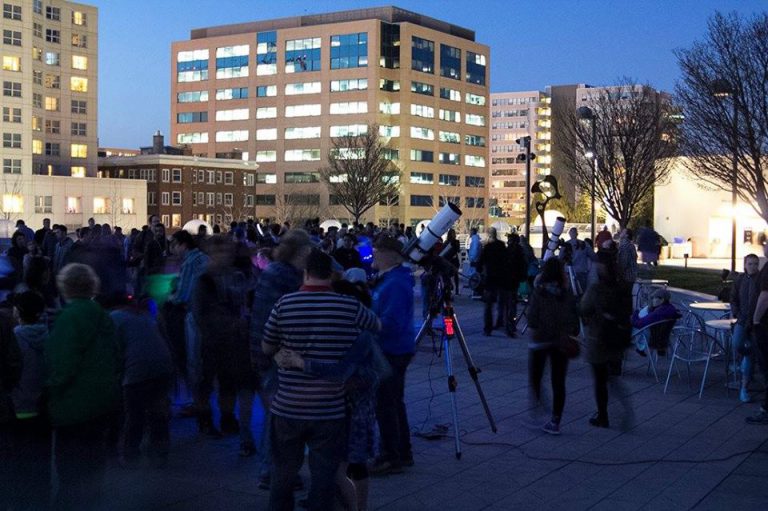
Explore the surface of the Moon and other celestial objects through telescopes provided by MAS members.
Young and old alike are invited to view the Moon and other celestial objects, such as Jupiter and Saturn, through a multitude of different telescopes provided by the Madison Astronomical Society (MAS). Activities include short kid-friendly presentations about the moon and other celestial phenomena, plus a kids’ fun zone with educational games and prizes!
If rain/cloud cover, family learning activities, presentations, and games will be moved inside.
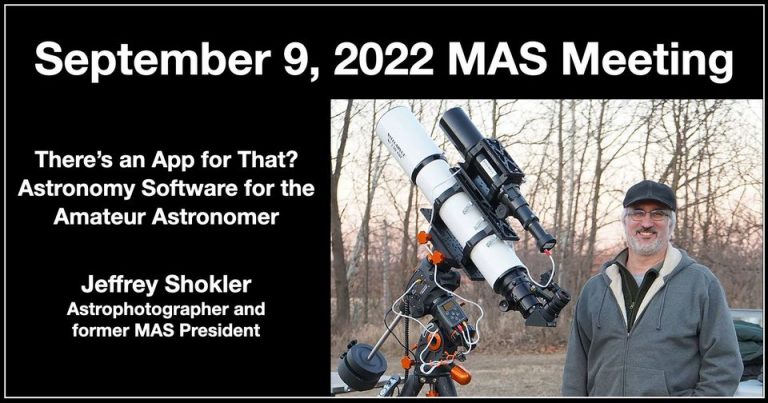
Is it going to be clear tonight? What’s the moon’s phase and what will I be able to see along the terminator? How bad is the smoke going to impact transparency for imaging tomorrow? Which moon of Jupiter just snuck out from behind the limb of the planet? How should I best orient my camera field of view to frame the DSO I want to shoot tonight? I haven’t seen the sky in months, what’s going to be up there this weekend when it is supposed to clear out?
Any of these questions sound familiar? If so, join Jeff as he shares his favorite “go-to” mobile, laptop, and browser-based applications and software for amateur astronomy. These range from free, on-line resources and “shareware,” to inexpensive but powerful mobile apps, to somewhat pricey desktop applications for image calibration, stacking, and processing. In his talk Jeff will cover software and apps to meet the wide-ranging needs of most amateur astronomers and astrophotographers including resources for weather forecasts and astronomical observing/imaging conditions, planetarium and simulation software for planning and learning, and much more!
Jeffrey Shokler is an amateur astronomer and astrophotographer with over three decades of experience in the hobby. He is a long-time member and past President, Vice-President, and Board Member of the Madison Astronomical Society. Jeff’s educational background is in anthropology, archaeology, and geoscience from Southern Methodist University in Dallas, TX, and the University of Wisconsin-Madison. He currently works at the University of Wisconsin-Madison as the Director for Technology and Assessment for the Office of Undergraduate Advising.
This meeting of the Madison Astronomical Society will be presented both live in-person at Space Place and online via Youtube.
Join the Friends of Donald County Park and Madison Astronomical Society at the Pop’s Knoll picnic area to view the planets and stars. Telescopes will be provided, but bring your own if you have one. Bring your family and friends, flashlight, insect repellent, blanket or chairs and marshmallows for roasting. Firepits will be ready.