
<<Introductory paragraph>>
Don’t buy a telescope just yet
If you’re interested in astronomy, but don’t know where to start, a good deal in a store may be enticing. But the best thing about them is usually the packaging. The box will make it look like you’ll be taking in the whole sky in a matter of minutes, but that’s rarely true. Everything from setting them up to getting a clear view through the eyepiece will be a challenge. We call these kinds of scopes “hobby killers.” But don’t fret, because there’s so much more to astronomy, and it doesn’t have to cost a lot. Read on.
Learn about the night sky
Put your phone to work with an astronomy app. There are many to choose from, but two apps that are quick to learn for beginners and experienced astronomers are Stelleriam and Sky Safari. Both show you the night sky with constellation overlays and have target lists and times for each day. They also have a calendar to plan for upcoming evenings and are ever present in your pocket. Both are free and have upgrades to consider later.
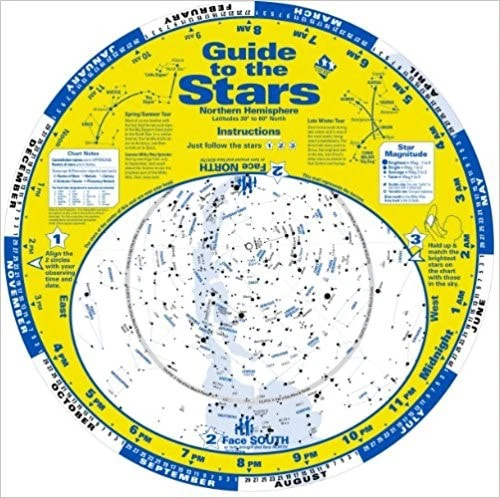
Also consider a planisphere, which can be purchased online for 10-30 dollars. Planispheres are a star maps for any date and time of the year. When buying one, be sure it’s for your latitude. In southern Wisconsin, that would be one between 40 and 50 degrees north. Planisphere tutorials can be found on Youtube.
Online calendars can help plan for a special event or a rare occurrence. There are numerous calendars online, but here are some of the more well-known ones:
Events can include a planetary conjunction, where two or more planets appear very close together, or a meteor shower, or even lunar and solar eclipses, and having a site or two in your bookmarks will help you keep up with important events.
Stargaze with binoculars
Chances are good that you have a great tool within your house that’s just waiting to be used. Any set that focuses for your eyes can be used, big or small. If you’re in the market for binoculars, don’t spend a lot of money on your first pair.
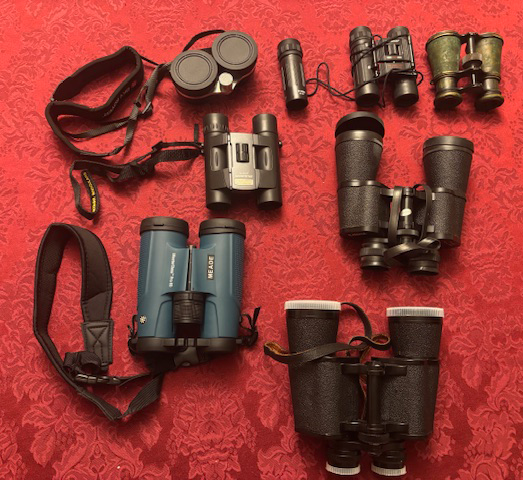
You’ll see two numbers when shopping for binoculars, such as 8×42 or 10×50. The first number is the magnification. The second number is the objective lens, or size of the opening on the big end. The bigger the number, the more light they collect.
Left: Craig’s collection
But keep in mind that bigger numbers mean bigger binoculars, and the harder they will be to hold steady. A general rule is 10x50s are the upper limit for handheld binoculars. After that, a tripod is generally used. My personal favorite set is 10×42, they’re a great balance of power and weight.
Buy a book or two
Books can be very helpful to backyard astronomers of all levels. Two of the best books to start with are Nightwatch by Terence Dickinson and Turn Left at Orion by Guy Consolmagno. Both are written to introduce new people to the night sky but contain a lot of information that you’ll return to over and over on your journey. If you can, buy the latest edition so that the planet and meteor charts in the back are current. But if you have an older copy, it’s still a great tool, since the text and star charts remain current.
Go to a public star party
We list star parties on our website, so you can find an event near you to meet other star enthusiasts and MAS group members will be there with telescopes, astrophotography gear and binoculars to help you experience the night sky. We’ll often include constellation and planetary discussions throughout the evening. Bring your binoculars, it’s always a great experience to find an object on your own right after seeing it in a telescope. You’ll never forget the first time you see Jupiter’s four biggest moons, or a star cluster like Pleiades! And it’s a great way to meet other people and see a variety of scope setups as you consider your own telescope.
Join an astronomy club
Now that you’ve explored the sky with binoculars, phone apps and star parties, the next step is to come to an MAS meeting, listed on our website. We’re a welcoming, friendly and enthusiastic group of star watchers. We have a beginners meeting just before the main meeting, where you can ask questions about telescopes, gear, or any general topics with people who love to share their experiences and spread the love of astronomy. We all started out with some trial and error and can share details of what to look for or avoid. The presentation each month is by topic experts or club members, with themes that can range from black holes to setting up a home observatory. Before you know it, you’ll be thinking about joining!
(Posted by Craig Jewell, September, 2025)